Human in the Loop AI: When Agents Must Stop and Ask
Human in the loop AI puts a person on the calls an agent should not make alone. Which actions need approval, how to design the checkpoint, what auditors want.
Agen.co
/16 min read
An AI model suggests. An AI agent acts. That one difference changes what human oversight has to mean, and most definitions of human in the loop AI have not caught up.
The classical definition comes from machine learning: a model produces an output, a person corrects it, and the correction becomes training data. Useful, but it describes a feedback loop around model quality. It says nothing about the agent that is, right now, about to issue a refund, revoke an employee's access, or push a change to production. For that agent, human in the loop is not a training technique. It is an authorization decision made at runtime, at a checkpoint, before the action lands.
This guide covers both senses of the term and then spends its time where the risk actually is: designing the checkpoint. Which actions should stop and wait for a person, what an approver needs to see, why mandated oversight so often decays into rubber-stamping, and what auditors will ask for when the EU AI Act applies to your deployment.
What is human in the loop AI?
Human in the loop AI (HITL) is any design in which a person is required to review, approve, correct, or reject part of an AI system's work before that work counts as final. In agent systems, the loop closes at the moment of action: the agent proposes what it wants to do, a policy decides whether a human must sign off, and the action executes only after the verdict.
Two loops share the name, and confusing them is the most common mistake in an oversight design review.
- The training loop (offline). Humans label data, rank outputs, and correct mistakes. Reinforcement learning from human feedback and active learning both live here. The goal is a better model. Latency does not matter, and no single human decision carries operational consequence.
- The action loop (runtime). An agent proposes a tool call against a real system. A human approves or refuses it in seconds or minutes. The goal is a safe, attributable action. Latency matters, and every decision is operationally consequential.
The rest of this page is about the second loop, because that is where autonomy meets liability. If you want the broader context of how these systems behave, start with what agentic AI is and how autonomy is layered into it.
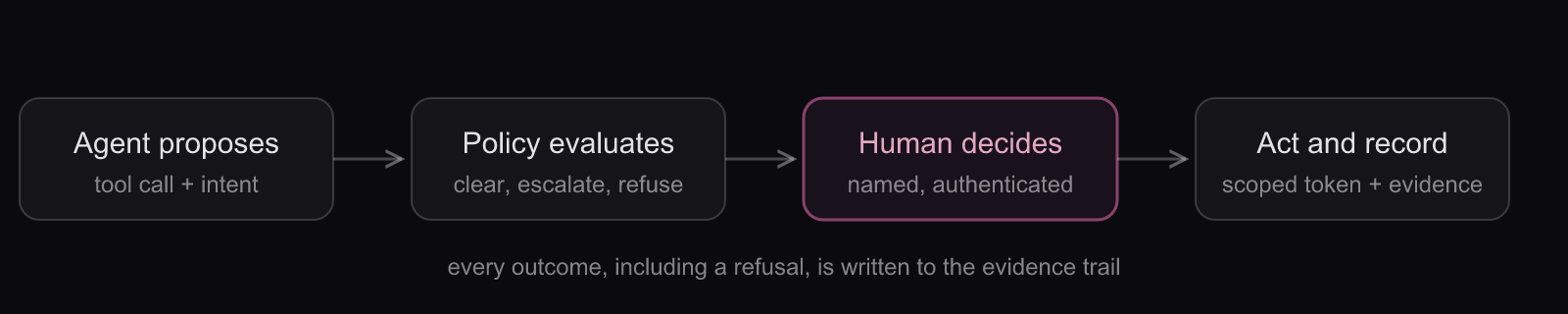
Read as text, the cycle is: the agent proposes a specific tool call with its intent and parameters; a policy evaluates that proposal and returns one of three verdicts, clear it automatically, escalate it to a named human, or refuse it outright; an authenticated person decides on the escalations; the action then executes with a scoped, short-lived credential, and every outcome, including refusals and timeouts, is written to an evidence trail.
Why human in the loop matters more for agents than for models
A chatbot that hallucinates produces a bad sentence. An agent that hallucinates produces a bad transaction. The blast radius moved from the screen to the system of record, and three properties of agents make that shift sharper.
Agents compose. A single instruction becomes dozens of tool calls, each individually reasonable, that add up to something nobody sanctioned. The dangerous step is rarely the first one.
Agents are steerable by their inputs. A calendar invite, a support ticket, or a web page can carry instructions the model treats as legitimate. That is prompt injection, and it turns the agent's own permissions into the attacker's permissions. The broader set of these techniques is covered in AI agent attacks, which maps the vectors and defenses in detail. Excessive agency is a named entry in the OWASP Top 10 for LLM applications, and the listed mitigations are exactly the two this page is about: constrain what the agent may do, and require human approval for high-impact actions.
Agents run without a witness. Automation's value is that nobody watches it. That is also why an error can repeat four hundred times before a person notices.
So the question stops being "is this output good?" and becomes "is this action allowed, right now, for this agent, on this data, and who is accountable for it?" That is an authorization question, which is why human in the loop belongs next to agent authorization rather than next to model evaluation. Authorization decides what an agent may do on its own; the human checkpoint decides what it may only do with a person's name attached. As Frontegg puts it in its analysis of why agent governance starts with guardrails, agents do not click buttons, they act, which moves the authorization decision to runtime.
Human in the loop vs human on the loop vs human in command
Oversight is not binary. Four modes sit on a spectrum, and a mature deployment uses different modes for different actions rather than picking one for the whole system.
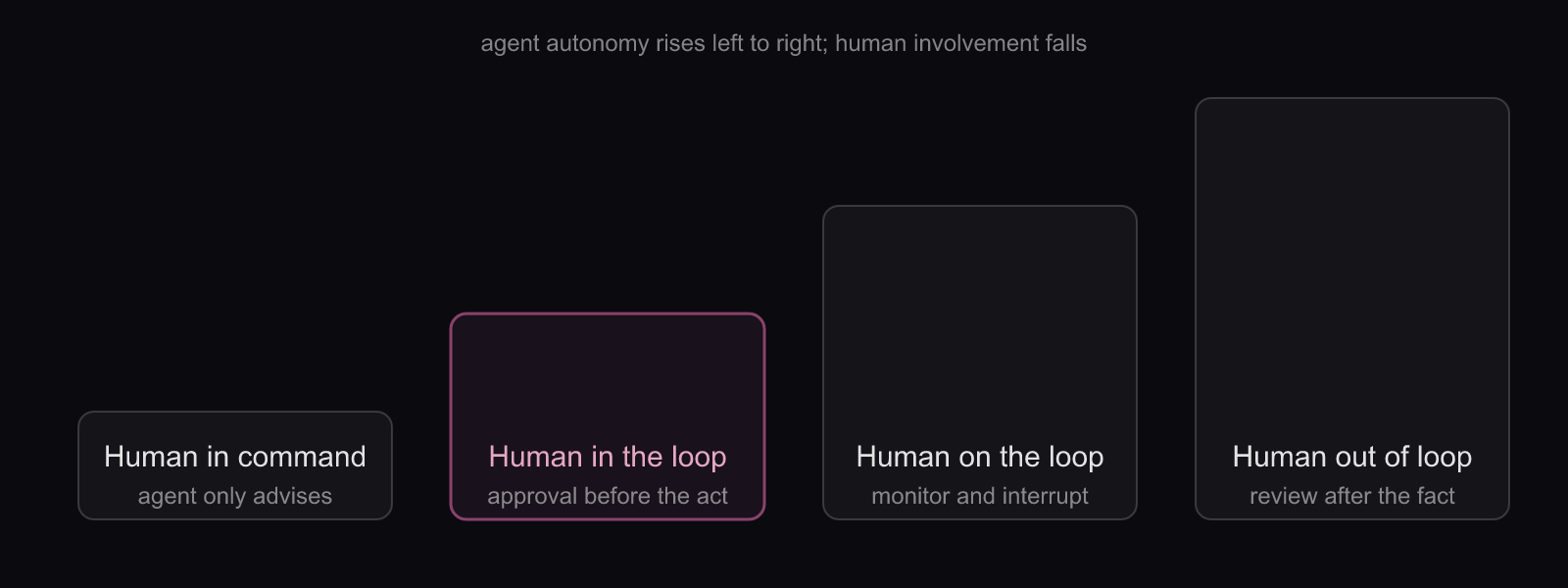
| Mode | Who decides | When the human acts | Best used for | Main risk |
|---|---|---|---|---|
| Human in command | The person | The agent only recommends; the person executes | Legal, clinical, and safety decisions with no acceptable error rate | Wastes the automation entirely |
| Human in the loop | The agent proposes, the person authorizes | Before the action executes | Irreversible or high blast radius actions | Approval fatigue and latency |
| Human on the loop | The agent | During execution, with the ability to interrupt | High volume, reversible actions under live monitoring | Nobody is actually watching |
| Human out of the loop | The agent | After the fact, through logs and audit | Low risk, fully reversible, well-bounded tasks | Damage is already done when you find it |
Two practical notes. First, human on the loop is the mode teams claim and rarely staff: a dashboard nobody watches is human out of the loop with extra steps. Second, mode should be a property of the action, not of the agent. The same support agent can refund forty dollars unattended and still need a person for a four thousand dollar refund. Mapping modes onto levels of agent autonomy makes that graduation explicit rather than accidental.
How a human in the loop checkpoint actually works
A working checkpoint is four layers, and teams usually build the middle two and forget the outer two. That is why oversight programs pass design review and fail audit.
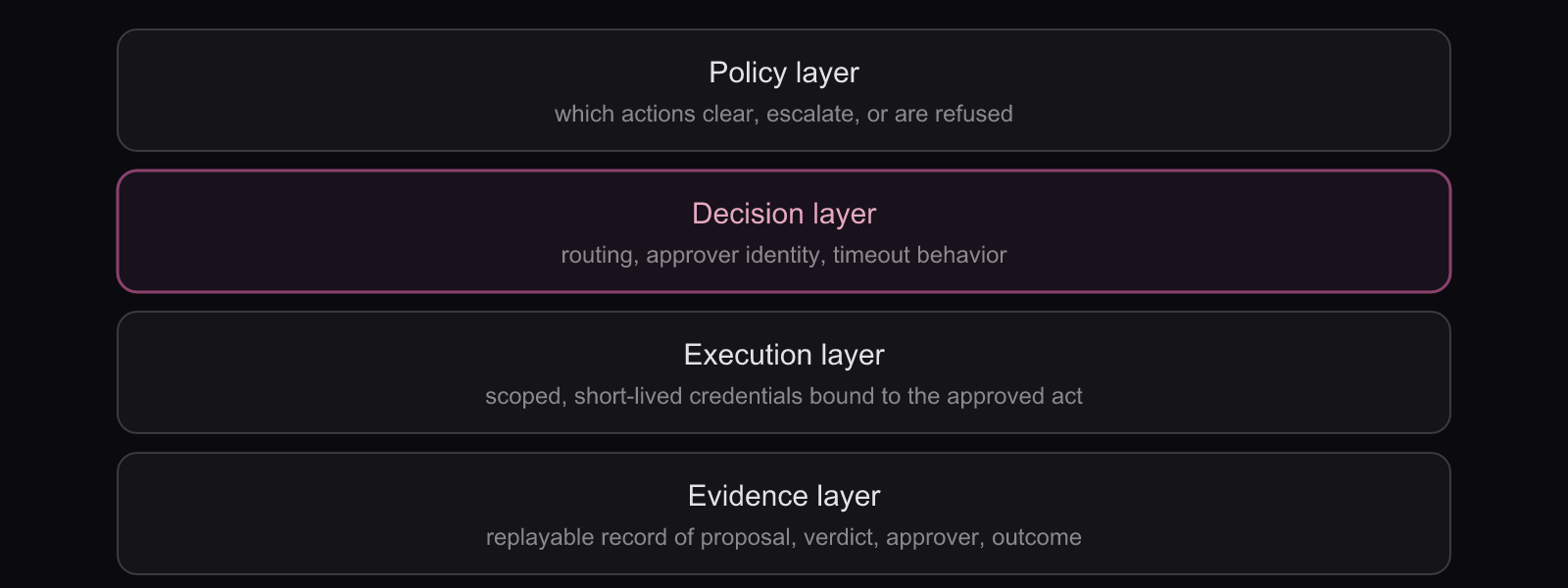
- The policy layer decides which proposed actions clear automatically, which escalate to a person, and which are refused without ever reaching a human. Refusal matters: sending every questionable action to a queue is how you train approvers to click yes. Deterministic controls that block a class of action outright belong here, which is the job of AI guardrails.
- The decision layer routes the escalation to a specific accountable person, authenticates them, and defines what happens on timeout. The default on timeout must be refusal, never silent execution. When the approver is the end user rather than an operator, this is where step-up authentication belongs, so consent is bound to a verified identity rather than a click.
- The execution layer gives the agent only the access the approved action needs, and only for as long as it needs it. Approval should mint a narrowly scoped, short-lived credential rather than unlock a standing one, which is the pattern described in ephemeral credentials.
- The evidence layer records the proposal, the policy verdict, the approver's identity, the decision latency, and the result, in a form that can be replayed months later. Without it you cannot answer the only question an auditor asks, which is who authorized this. See how to audit AI systems and autonomous agents for what that record must contain, and AI observability for the runtime telemetry that feeds it.
Two failure patterns follow directly from skipping a layer. Skip the policy layer and every action becomes an escalation, which produces approval fatigue within a week. Skip the evidence layer and you have a workflow, not a control: the approval happened, but you cannot prove it, and an unprovable control is worth nothing in an audit.
Which agent actions need human in the loop approval
This is the design decision that determines whether the whole program works. Too few checkpoints and the agent does something nobody sanctioned. Too many and the approvals become reflexive, which is worse than having none, because now the rubber stamp carries a human name.
Score each action the agent can take on four dimensions, then let the score choose the oversight mode.
- Reversibility. Can the action be undone, and by whom, and how fast? A draft email is reversible. A sent email is not.
- Blast radius. One record, one customer, one team, or the whole tenant?
- Data sensitivity. Does the action read, move, or expose regulated or confidential data? Exfiltration usually looks like a permitted read followed by a permitted write.
- External visibility. Does anyone outside the company see the result? Customer-facing and regulator-facing actions carry reputational cost that no rollback recovers.
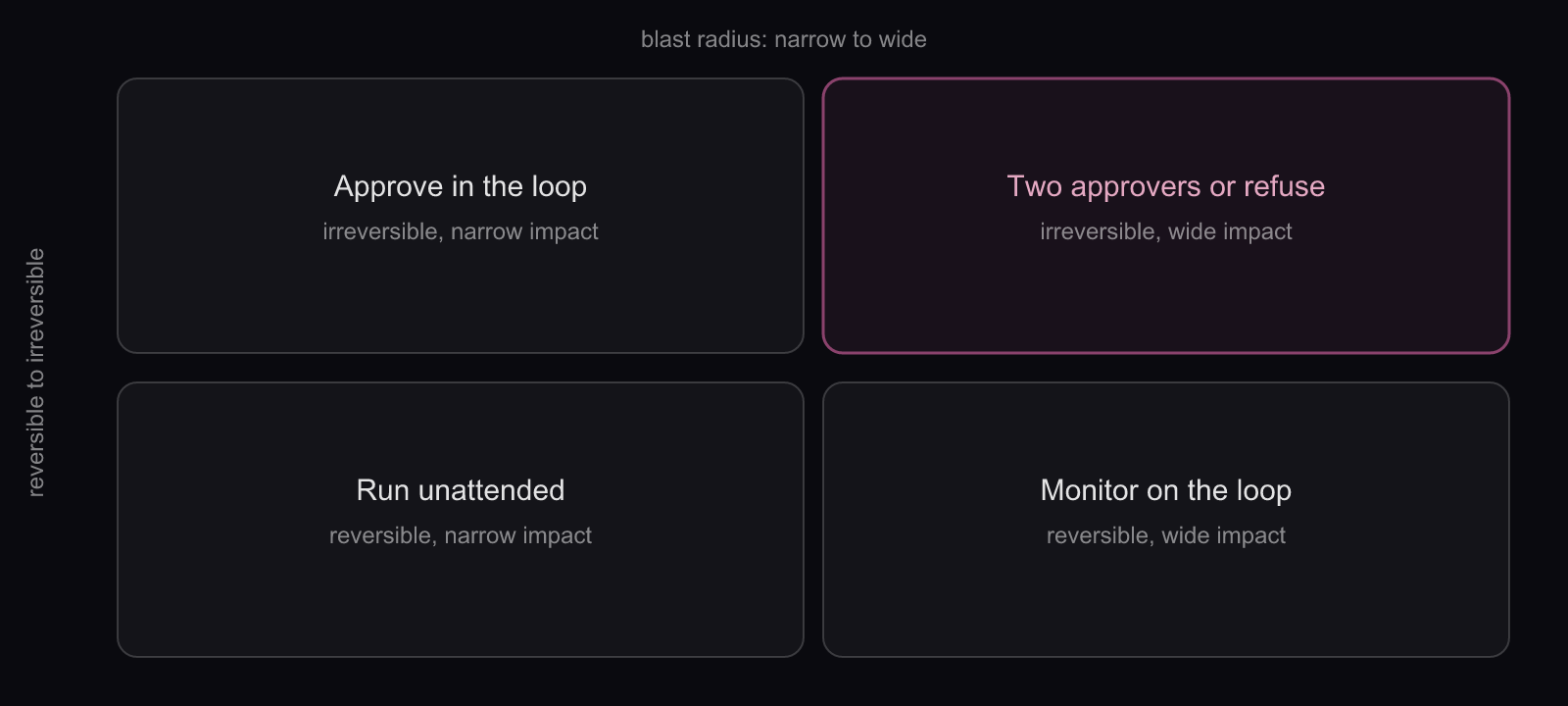
| Tier | Profile | Oversight mode | Examples |
|---|---|---|---|
| Tier 0 | Reversible, narrow, no sensitive data | Unattended, logged | Read a ticket, summarize a document, draft a reply, query a dashboard |
| Tier 1 | Reversible, wide, or internally visible | Human on the loop with rate limits and alerts | Update fifty CRM records, reassign a sprint, post to an internal channel |
| Tier 2 | Irreversible or externally visible or regulated data | Human in the loop approval before execution | Issue a refund, email a customer, delete a record, grant access, deploy code |
| Tier 3 | Irreversible and wide and high value | Two named approvers, or refuse by policy | Bulk delete, payroll or payment runs, production database changes, permission grants to another agent |
Tier the actions once, in a workshop with the business owner rather than only the security team, and keep the tiering in version control next to the policy that enforces it. If you have already scored your agents using an agentic risk map, reuse those scores here instead of inventing a second scale.
One more rule earns its place: an agent that can change its own permissions, spawn another agent, or grant access to a second agent is always at least Tier 2, whatever the immediate blast radius looks like. In multi agent systems, privilege spreads faster than anybody's mental model of it.
Anatomy of an approval a human can actually judge
Most approval requests fail the reader. A notification that says "Agent Atlas wants to call salesforce.update_opportunity. Approve?" gives a person nothing to decide with, so they decide on vibes. An approval request is a briefing document, and it needs six fields.
| Field | What it answers | Weak version | Strong version |
|---|---|---|---|
| Intent | Why is the agent doing this? | Tool call requested | Closing ticket 4182 by refunding the duplicate charge the customer reported |
| Exact effect | What changes if I approve? | Update record | Refunds $420.00 to card ending 4417, marks invoice INV-9931 void |
| Provenance | Who or what asked for this? | User request | Instruction originated in the customer's reply on ticket 4182, not in an attached file |
| Blast radius | How far does it reach? | Standard action | 1 customer, 1 invoice, reversible within 24 hours by finance |
| Policy context | Why me, and is this normal? | Approval required | Above the $250 unattended limit; this agent has requested 3 refunds today, average $86 |
| Decision options | What can I do besides yes? | Approve or deny | Approve once, approve with a lower amount, deny, deny and quarantine the agent |
Provenance deserves particular attention. When an agent's instruction came from content it read rather than from the person it works for, the approval screen is the last place anyone can catch it. Showing the origin of the instruction turns a generic approval into a genuine review, and it is the single most effective defense against an injected action that looks perfectly ordinary at the tool-call level.
Also give the approver something other than a binary. Real decisions are rarely "yes exactly this" or "no never": the useful middle options are approve with narrower parameters, approve once rather than for the session, and deny plus quarantine. An approval interface with two buttons produces approvals.
The failure mode nobody plans for: approval fatigue and automation bias
Here is the uncomfortable research. Requiring a human to approve an automated decision does not reliably produce human judgment. Decades of human factors work describe automation bias, the measured tendency to defer to a system's recommendation and stop applying independent scrutiny, particularly when the system is usually right. Scholarship on algorithmic oversight policy makes the sharper point: mandating a human reviewer often fails on its own terms, because the policy assumes a quality of attention that people cannot sustain at queue scale.
The legal analysis of the EU AI Act's oversight duty reaches the same conclusion from the other direction: automation bias has to be designed out of the interface, because it cannot be trained out of the reviewer.
There is a second cost. When oversight is nominal but documented, the approver becomes the liability sponge for a system that was designed to fail, and the organization gains a defense rather than a control. That is a governance outcome nobody intends and many programs produce.
Four design choices measurably reduce the decay:
- Keep the queue small on purpose. Approval volume is a budget, not an outcome. If approvers see more than a few requests an hour, the policy layer is doing too little filtering. Refuse the obviously wrong actions rather than escalating them.
- Show reasoning, not just a request. Explanations that expose the basis of a decision reduce reflexive acceptance, while a bare recommendation invites it.
- Measure approver behavior. Track the denial rate, the median time to decide, and the share of approvals under five seconds. An approver who has never denied anything is a signal, not a star performer.
- Rotate and scope the duty. Route approvals to the person who owns the affected system rather than to a general queue, and cap how long any one person sits on the rota. Ownership restores attention that volume destroys.
Fatigue is also why the unattended tier matters so much. Every action you can safely automate protects the attention available for the actions you cannot.
What regulators expect from human oversight
Human oversight is no longer only an engineering preference. For high-risk systems under the EU AI Act, it is a design obligation: Article 14 of the EU AI Act requires that high-risk AI systems be built so that natural persons can effectively oversee them while in use, with measures proportionate to the risks, the level of autonomy, and the context of use. Deployers carry a matching duty under Article 26 to assign oversight to people who are competent, trained, and actually supported to do it.
The NIST AI Risk Management Framework approaches it as accountability structure rather than a single control: its GOVERN function expects documented roles, authority, and escalation paths for AI decisions, and its MANAGE function expects those paths to be exercised and evidenced.
| Requirement | What it means in an agent deployment | Evidence to keep |
|---|---|---|
| Oversight is designed in, not added on | The checkpoint is enforced by policy at the action layer, not by a team norm | Versioned policy, tier map, enforcement logs |
| Measures proportionate to risk and autonomy | Tiered oversight modes rather than one blanket rule | The action tiering with its rationale |
| Oversight is effective, not nominal | Approvers can understand and can actually refuse | Denial rates, decision latency, approval interface screenshots |
| Assigned to competent, supported people | Named approver roles with training and a rota | Role assignments, training records |
| Ability to intervene or stop | A working kill switch and quarantine for a misbehaving agent | Tested interrupt procedure with timestamps |
| Traceability of the decision | Every approval tied to a person and a proposal | Replayable evidence trail |
If the EU AI Act applies to your deployment, read the obligations in full in the guide to EU AI Act compliance, and map your controls with the NIST AI Risk Management Framework. Both sit inside the broader program described in the complete guide to AI agent governance.
Best practices for human in the loop AI
- Tier actions, not agents. Oversight is a property of what is being done. One agent should run unattended for most of its work and stop for the few actions that matter.
- Make refusal a first-class verdict. A policy that can only escalate will bury its approvers. Some actions should never reach a human, because the answer is already no.
- Bind approval to identity, not to a channel. A thumbs-up in a chat room is not an authorization record. The approver must be authenticated, and for user-facing consent that means a step-up challenge at the moment of decision.
- Fail closed on timeout. If nobody answers within the window, the action does not happen. Publish the window so the agent's owner can design around it.
- Approve the action, not the session. Grant the narrowest credential that completes the approved act and expire it immediately after. Standing access re-creates the risk the checkpoint removed.
- Give approvers a real budget. Set a target for approvals per approver per hour and treat breaches as a policy defect to fix upstream.
- Instrument the humans too. Denial rate, time to decide, and escalation volume tell you whether oversight is real. Review them monthly.
- Record refusals and timeouts as carefully as approvals. The actions that did not happen are often the most valuable evidence you hold.
- Re-tier after every incident and every new tool. A new integration changes the blast radius of an agent you already approved.
Implementation checklist
- Inventory every tool and action each agent can invoke, including indirect ones through other agents.
- Score each action on reversibility, blast radius, data sensitivity, and external visibility.
- Assign a tier and an oversight mode to each action, and record the rationale.
- Write the policy as enforceable rules at the action layer, with clear, escalate, and refuse verdicts.
- Name an accountable approver role for every escalating action, with a backup and a rota.
- Design the approval request with all six fields, including provenance of the instruction.
- Set the timeout window and confirm the system fails closed.
- Wire approval to short-lived, narrowly scoped credentials rather than standing access.
- Emit a replayable evidence record for every proposal, verdict, approver, and outcome.
- Add approver metrics to the monthly governance review: volume, denial rate, decision latency.
- Test the interrupt path: can a person stop an agent mid-task, today, without a deploy?
- Re-run the tiering whenever an agent gains a tool, a scope, or a downstream agent.
Running this at enterprise scale is where most teams stall, because the checkpoint has to sit in the path of every agent action without becoming a bottleneck: policy evaluated in milliseconds, approvals routed to the right human, credentials minted per action, and an evidence trail that survives an audit. Agen.co provides that accountability layer across the agents your teams already use, so oversight becomes a property of the environment rather than a feature each agent has to implement on its own.
Frequently asked questions
What is human in the loop AI?
Human in the loop AI is any design where a person must review, approve, or reject part of an AI system's work before it counts as final. In agent systems it means a policy escalates a proposed action to a named human, who authorizes or refuses it before the action executes against a real system.
What is the difference between human in the loop and human on the loop?
Human in the loop means the action waits for a person's approval before it happens. Human on the loop means the agent acts on its own while a person monitors and can interrupt. In the loop prevents the mistake; on the loop only shortens it, and only if someone is genuinely watching.
Which AI agent actions need human approval?
Escalate actions that are irreversible, externally visible, touch regulated data, or reach beyond a single record. Refunds, outbound customer messages, deletions, access grants, and production changes are typical. Reversible, low impact actions should run unattended, because protecting approver attention is what keeps the important approvals meaningful.
Does human in the loop slow AI agents down?
Only where you choose it to. A well-tiered deployment runs most actions unattended and pauses for a small minority, so median latency barely moves. The real cost appears when everything escalates, which signals a policy layer that is filtering too little rather than an oversight model that is too strict.
Is human oversight required by the EU AI Act?
For high-risk AI systems, yes. Article 14 requires providers to design systems that natural persons can effectively oversee in use, with measures proportionate to the risk, autonomy, and context. Deployers must assign that oversight to competent, trained people. Nominal review that nobody can exercise does not satisfy the requirement.
How do you stop human in the loop review from becoming a rubber stamp?
Cut the queue so approvers see few requests, show the reasoning and the provenance of each one, offer options beyond approve and deny, route each request to the owner of the affected system, and track denial rate and decision time. An approver who never refuses anything is a warning sign.
Where to go deeper
- Agent authorization: how permissions, delegation, and on-behalf-of flows decide what an agent may do before a human is ever asked.
- Step-up authentication: how to bind a human in the loop approval to a verified identity at the moment of decision.
- Ephemeral credentials: why an approval should mint short-lived, scoped access instead of unlocking standing permissions.
- AI guardrails: the deterministic controls that refuse an action outright so it never reaches an approver.
- Agentic risk map: how to score agent risk so your action tiering rests on evidence.
- AI audit: what the evidence trail behind every approval has to contain.
- AI agent workforce management: how oversight duties fit into running a fleet of agents day to day.
Human in the loop AI works when it is engineered as an authorization checkpoint: a policy that knows which actions deserve a person, an interface that lets that person genuinely decide, credentials that expire with the task, and a record that survives an audit. If you want to see that checkpoint running across the agents your teams already use, book a demo and bring your hardest action tier.
Keep reading
More from AI Agent Identity & Access
AI Agent Identity & Access
Workload Identity Federation: How Trust Replaces Secrets
Workload identity federation lets services and AI agents get short-lived cloud credentials from a configured trust relationship, not a stored secret.
Agen.co·
AI Agent Identity & Access