Ephemeral Credentials: How Short-Lived Access Works
What ephemeral credentials are, how they are issued, how long they should live, and how to move AI agents off static secrets without breaking production.
Agen.co
/17 min read
Every credential in your environment carries two numbers: how long it stays valid, and how much it can do while it is. Those two numbers decide what an attacker gets when the credential leaks. Rotating a secret on a ninety-day schedule changes neither of them, because for eighty-nine of those days the secret is still a standing key to production.
Ephemeral credentials attack both numbers at once. They are issued at the moment of use, scoped to a single purpose, and they expire on their own. That model was already the right answer for cloud workloads. AI agents make it the only answer, because an agent takes thousands of actions without a person watching, and a credential it holds for a week is a credential it can misuse for a week.
This guide covers what ephemeral credentials are, the machinery that issues them, how long they should actually live, what breaks when you shorten lifetimes, and how to migrate a real environment off static secrets. For the mechanism that lets a service obtain one of these credentials with no stored secret at all, see workload identity federation.
What are ephemeral credentials?
An ephemeral credential is a credential that is minted on demand for a specific caller and a specific purpose, carries a lifetime measured in seconds or minutes, and becomes useless when that lifetime ends without anyone having to revoke it. Nothing durable is stored, so there is nothing durable to steal.
Three properties have to hold together. Drop any one and you have a shorter static secret rather than an ephemeral one.
- Issued on demand. The credential does not exist until a caller asks for it and proves who it is. There is no file, no vault entry, and no environment variable holding it between uses.
- Scoped to a purpose. It is bound to an audience (which service will accept it) and a set of permissions (what it may do there). A credential that can do everything the parent account can do is not scoped, however briefly it lives.
- Self-expiring. Expiry is a property of the credential, not a task on someone's queue. Revocation still matters for emergencies, but the default path to invalidity is the clock.
The zero trust model that most enterprise security programs now follow makes the same argument from the top down: access decisions should be made per session and per request, as NIST's Zero Trust Architecture puts it rather than granted once and left standing. Ephemeral credentials are what that principle looks like at the credential layer.
Ephemeral, short-lived, temporary, dynamic: one idea, four words
The vocabulary is fragmented because four communities arrived at the same control separately. In practice the terms are interchangeable, and you will see all four in the same architecture review.
- Short lived credentials is the infrastructure and DevOps phrasing, usually about CI/CD pipelines and database access.
- Temporary credentials is the cloud-provider phrasing for the time-boxed keys a security token service hands back.
- Dynamic secrets is the secrets-management phrasing, emphasizing that the credential is generated per request rather than stored.
- Ephemeral credentials is the identity phrasing, and the one that travels best, because it names the property that matters instead of the tool that produces it.
Treat them as synonyms. What actually differs between implementations is lifetime, scope granularity, and whether the credential can be used by anyone who steals it.
Why standing credentials fail when agents do the work
A static API key is a bearer instrument. Whoever holds it is the account, and nothing about the request distinguishes your deployment pipeline from an attacker replaying the same key from a different continent. Stolen credentials have remained one of the leading ways attackers get their initial foothold in breach data, year after year, for exactly this reason.
Autonomous software changes the shape of that exposure in three ways.
Agents multiply the number of identities. Every agent, every tool it calls, and every workflow it participates in is a caller that needs authority. These are non-human identities, and they already outnumber employees in most enterprises by a wide margin. Handing each of them a standing key produces a credential inventory nobody can audit.
Agents act without a witness. A person who is phished notices something eventually. An agent running on a schedule at three in the morning does not notice anything. If its credential is broad, the window between compromise and discovery is the window between compromise and your next log review.
Agents decide what to call next. This is the part that is genuinely new. A pipeline executes a fixed script; an agent selects its own next action from whatever tools it can reach. OWASP catalogues this as excessive agency: the agent is granted more permission, more tools, or more autonomy than the task requires, and the extra capability gets used. A static key with broad scope is excessive agency in credential form.
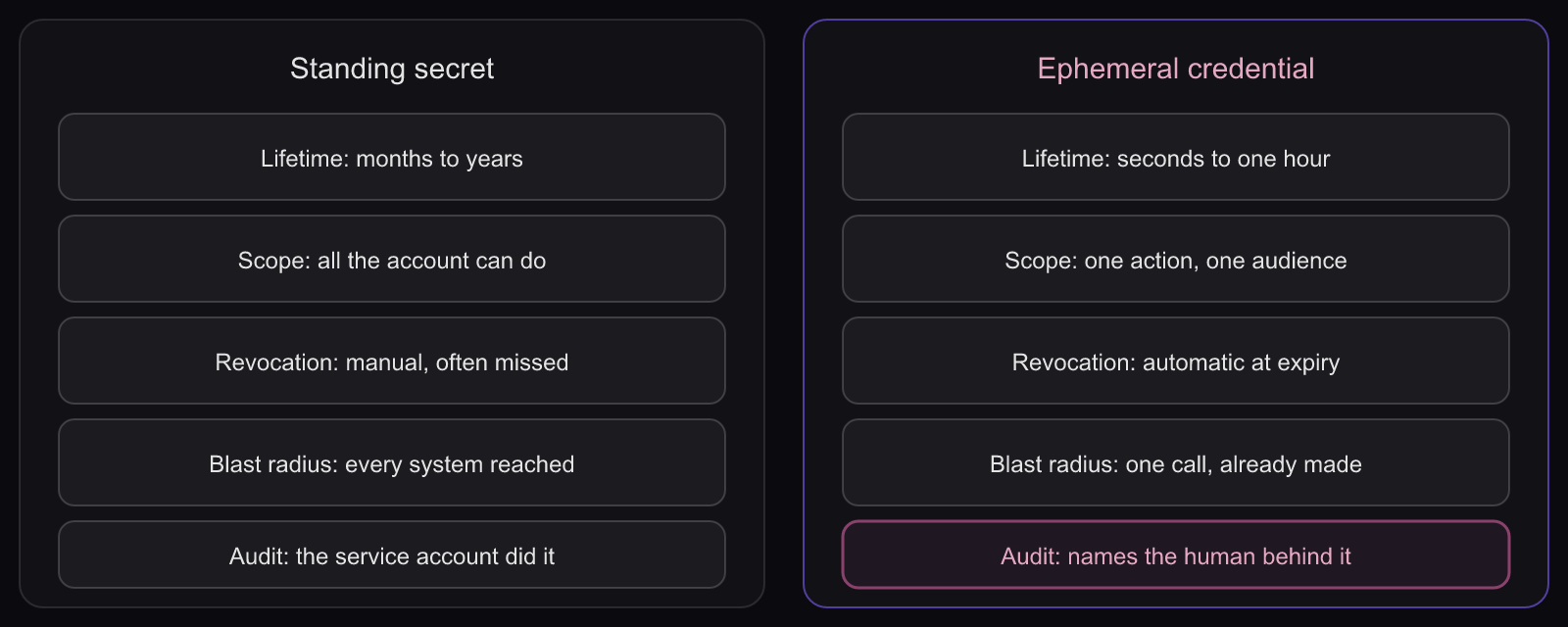
| Property | Standing secret | Ephemeral credential |
|---|---|---|
| Lifetime | Months to years, until someone rotates it | Seconds to one hour, then invalid |
| Scope | Everything the owning account can do | One action against one audience |
| Revocation | Manual, and frequently forgotten | Automatic at expiry, manual only for emergencies |
| Blast radius on theft | Every system the account can reach, indefinitely | One call that has usually already completed |
| Audit trail | Attributes the action to a shared service account | Attributes the action to the agent and the human who delegated it |
How an ephemeral credential is issued
The mechanism is the same whether the caller is a container, a build job, or an AI agent. Something proves its identity to an issuer, the issuer applies policy, and a narrowly scoped credential comes back with an expiry attached.
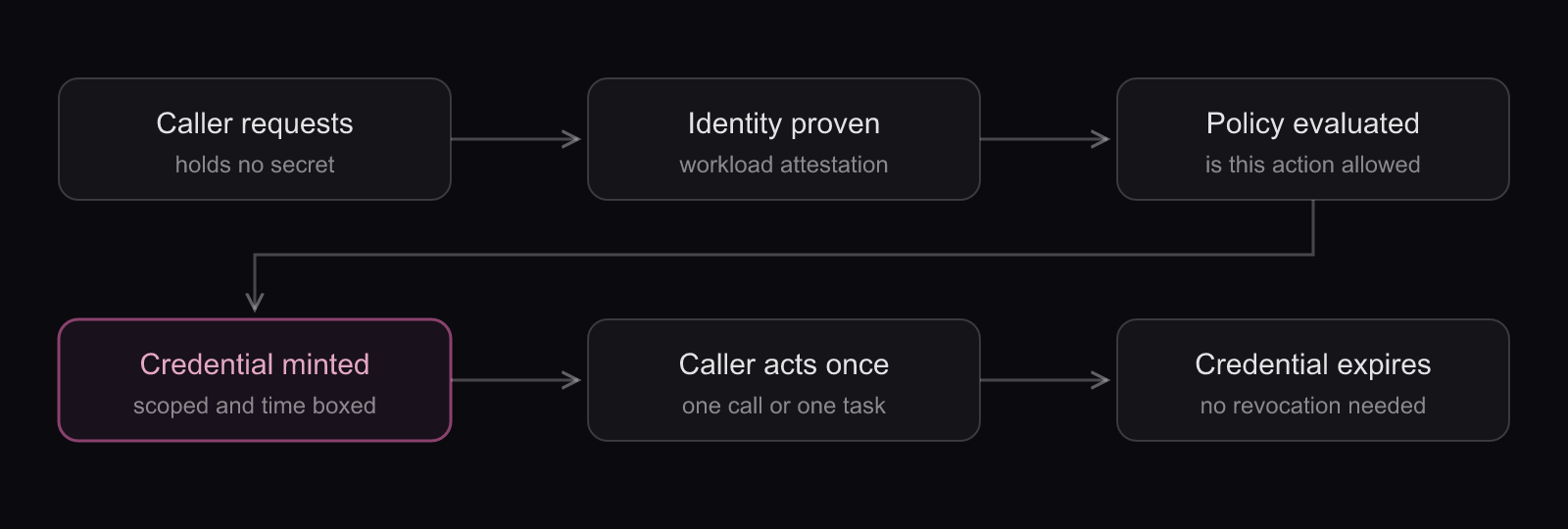
- The caller requests access for a named action, holding no long-term secret of its own.
- The issuer proves the caller's identity from something the caller cannot forge: a platform-signed attestation, a cloud instance document, a client certificate, or an already-verified upstream token.
- Policy is evaluated against that identity and the requested action. This is the decision point, and it is where a denial costs nothing.
- A credential is minted with an audience, a permission set, and an expiry stamped into it.
- The caller performs the action and, in the strictest designs, discards the credential immediately afterwards.
- The credential expires on its own. Nothing has to be cleaned up, and nothing is left behind for an attacker to find later.
The issuing authority becomes the new trust anchor
Removing static secrets does not remove trust. It concentrates it. A security token service (STS), an identity provider, or a workload identity platform now decides who gets what, and its availability and correctness become production concerns. That concentration is the point: one place to enforce policy, one place to log, one place to change when something goes wrong. It also means the issuer deserves the operational rigor you previously spread across every secret store, which is covered in the failure modes below.
Token exchange narrows a credential on the way down
OAuth token exchange is the standardized way to trade one token for a narrower one. A service that receives a token, and then needs to call a second service on the original caller's behalf, exchanges the incoming token for a new one scoped to that downstream audience only. The exchange is defined by RFC 8693, the OAuth 2.0 Token Exchange specification, which specifies the request, the subject and actor token parameters, and how the resulting token records the delegation.
This matters for agents more than for anything else. When an agent calls a tool and that tool calls a third system, token exchange is what stops the original broad token from being forwarded verbatim down the chain. Each hop gets a credential sized for that hop, and the actor claim records who passed it along. The base OAuth 2.0 authorization framework already assumes access tokens are short-lived and that the longer-lived grant lives in a refresh token held by the client, not in the credential presented to the resource.
Workload identity removes the bootstrap secret
Every ephemeral credential scheme faces the same question: what does the caller present to get its first credential? If the answer is another secret, you have moved the problem rather than solved it. That first secret has a name in the industry, secret zero, and it is where most short-lived-credential projects quietly fail.
Workload identity answers it with attestation instead of a secret. The platform the workload runs on vouches for it, and the issuer trusts the platform rather than a string. SPIFFE, the vendor-neutral workload identity standard, formalizes this: a workload receives a short-lived identity document that is automatically rotated, with no operator-managed secret involved.
Binding the credential to whoever holds it
A short lifetime shrinks the window for theft. It does not close it. A bearer token stolen in its first second is valid for the rest of its life in anyone's hands. Sender-constrained tokens fix that by binding the credential to a key the legitimate client holds.
- DPoP, demonstrating proof of possession binds the token to a key the client proves possession of on every request, so a token lifted from a log or a proxy is not usable by itself.
- Mutual TLS certificate-bound access tokens achieves the same binding by tying the token to the client certificate used on the connection.
Short plus bound is meaningfully stronger than short alone. If you are designing the issuance path now, design for binding now, because retrofitting it across every client later is the expensive version.
Rotation, expiry, and revocation are not the same control
Most confusion about this topic collapses three different controls into one word. They answer different questions and they fail differently.
| Rotation | Expiry | Revocation | |
|---|---|---|---|
| Question it answers | How often does the secret change? | How long is any one credential useful? | How fast can we kill a credential right now? |
| Trigger | A schedule or a person | The clock, automatically | An incident or a policy change |
| Typical interval | 30 to 365 days | Seconds to one hour | Minutes, if the plumbing exists |
| What it does not fix | The credential is still standing between rotations | Credentials already issued stay valid until they lapse | Requires detection first, and something to call |
| Operational cost | High and recurring, and it is where outages come from | Near zero once automated | Low to build, high to exercise correctly |
The practical reading: rotation is a compensating control for credentials that should not exist. Expiry is the real control. Revocation is the emergency brake you still need, because a compromised credential with a fifteen-minute lifetime is fifteen minutes of access you may want to end in the first two.
How long should an ephemeral credential live?
There is no universal number, but there is a rule: the lifetime should be slightly longer than the work it authorizes, and never long enough to be worth stealing. Start from the duration of the action and add a margin for clock skew and retries.
| Caller | Typical TTL | Why |
|---|---|---|
| Single API call by an AI agent | 60 seconds to 5 minutes | The action completes in under a second; the margin covers retry and skew |
| Agent task spanning several tool calls | 5 to 15 minutes | Bound the task, not the session; re-mint if the task runs long |
| Interactive human session with elevated rights | 5 to 15 minutes of elevation | Pair with step-up verification at the start of the window |
| CI/CD job | Job duration plus 5 minutes | Long enough to finish, short enough that a leaked log line is stale |
| Database connection credential | 15 to 60 minutes | Connection pools amortize the mint cost; shorter causes churn |
| Workload identity document | Minutes to an hour, auto-rotated | The platform rotates it, so the number is an availability trade-off |
Two floors constrain how short you can go. The first is clock skew: if issuer and verifier disagree by thirty seconds, a sixty-second credential is a coin flip. Synchronize time before you shorten lifetimes. The second is mint cost: every credential is a round trip to the issuer, and an agent fleet making millions of calls a day will feel it in both latency and issuer load. Batching at the task boundary rather than the call boundary is usually the right compromise.
Ephemeral credentials for AI agents: the delegation chain
Here is where agent credentials stop resembling workload credentials. A container acts for itself. An agent acts for somebody. When the agent files an expense, deletes a record, or sends a message, the question that gets asked afterwards is never "which service account was that". It is who is accountable for this action, and the credential is the only artifact in the request that can carry the answer.
That makes an agent credential a borrowed credential. It has to encode a chain, not an identity.
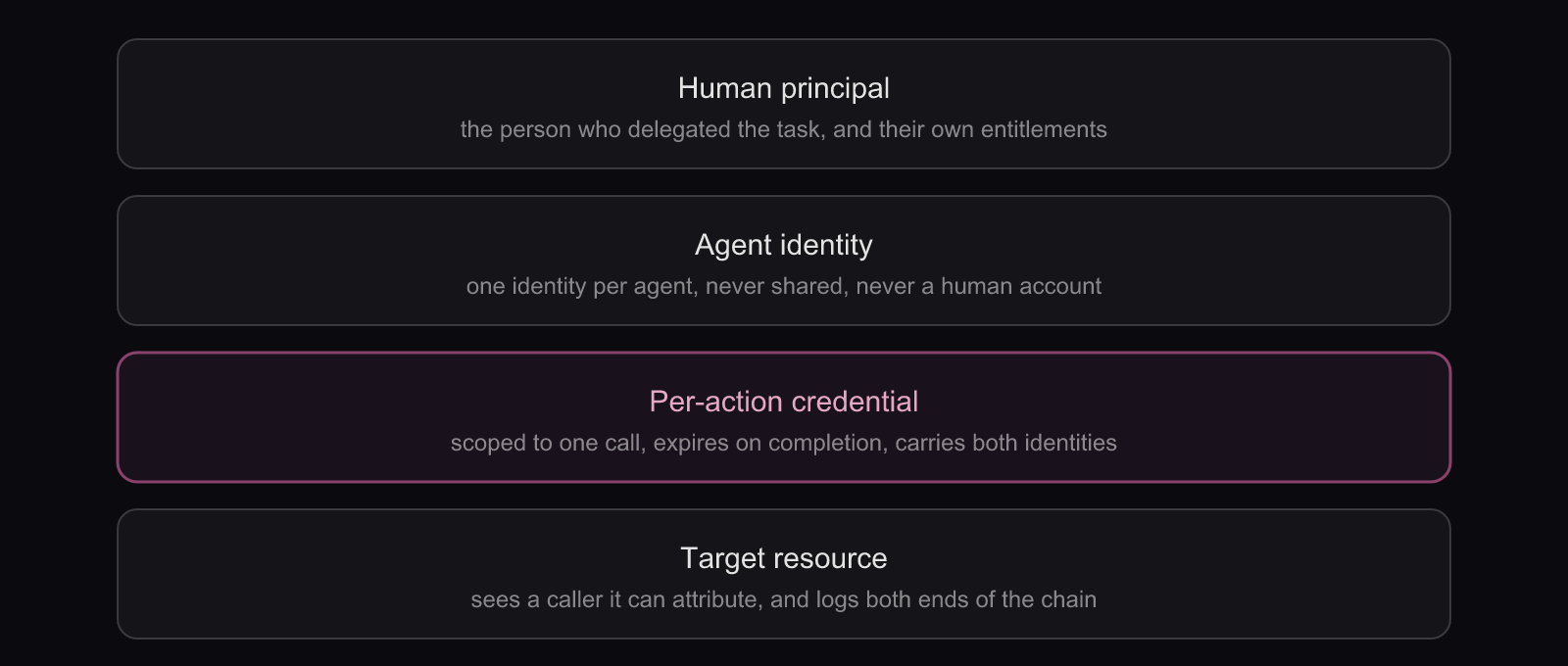
Each layer contributes something the audit log needs:
- Human principal. The person who delegated the work. Their entitlements are the ceiling: an agent must never be able to do something its principal could not.
- Agent identity. A first-class identity for the agent itself, distinct from any human account and never shared between agents. Frontegg makes the same argument for managing agent identity as a first-class identity: an agent that borrows a person's credentials is invisible in every log that matters.
- Per-action credential. The ephemeral credential, scoped to one call, carrying both the agent identity and the delegating principal. This is what token exchange produces when the actor and subject are recorded separately.
- Target resource. The system being called, which can now log a caller it can attribute rather than a shared key.
Two controls complete the picture. When a requested action exceeds what the delegation should cover automatically, the right response is not to widen the credential but to pull the person back in: that is step-up authentication, which interrupts the agent and asks the human to approve the specific action before a credential is minted for it. And where the credential sits relative to the model, the tools, and the enforcement point is a structural decision covered in our guide to AI agent architecture.
For agents reaching tools over the Model Context Protocol, the handshake that establishes this identity in the first place has its own rules, covered in MCP authentication.
What breaks when you shorten credential lifetimes
Every page that recommends this control stops at the benefits. Here is the part you will actually spend your time on.
- Clock skew turns into authentication failures. Short lifetimes make time synchronization a hard dependency. A drifting host produces errors that look like permission problems and get debugged as permission problems for a day and a half.
- Long-running work outlives its credential. A three-hour data job with a fifteen-minute token fails at minute sixteen unless the client refreshes mid-flight. Every SDK in the path needs to handle re-minting, and the ones that do not will need wrapping.
- Retry storms hit the issuer. When a downstream service degrades, clients retry, each retry mints, and the issuer absorbs a traffic spike at exactly the moment the environment is already unhealthy. Cache credentials for their usable life and back off on failure.
- The issuer becomes a single point of failure. If nothing can get a credential, nothing can do anything. Issuer availability now needs the same treatment as your database: redundancy, capacity headroom, and a tested failure plan.
- The minting path becomes the new secret zero. Whatever proves identity to the issuer is now the most valuable thing in the environment. If that is a static bootstrap key sitting in an image, you have rebuilt the problem with more steps.
- Expired-token errors are hard to read. Failures move from "this key is wrong" to "this key was right ninety seconds ago", which is harder to reason about in a stack trace. Log the issuance identity, the scope, and the expiry on every denial.
- Cost and latency at agent scale are real. An agent fleet making millions of calls a day pays a round trip per mint. Mint per task rather than per call where the risk model allows it.
None of these is a reason to keep static secrets. They are the reason to sequence the migration deliberately, and to score which systems are worth doing first. An agentic risk map is a reasonable way to rank them by what an agent could actually reach.
Best practices for ephemeral credentials
- Give every agent its own identity. Never let agents share a credential, and never let an agent run as a human user. Shared credentials destroy attribution permanently, and no amount of expiry brings it back.
- Scope to the audience, not just the action. Set the audience claim so a credential accepted by one service is rejected by every other. This one field stops most token-replay paths.
- Set the lifetime from the work. Start at the action's duration plus a skew margin, then raise it only when a measured failure tells you to. Do not start at an hour because the default was an hour.
- Bind the credential to its holder. Use DPoP or mutual TLS so a stolen credential is useless without the key that goes with it.
- Kill secret zero. Bootstrap with platform attestation or workload identity federation. If the answer to "how does the first credential arrive" is a file, the design is not finished.
- Exchange, do not forward. When a service calls another on a caller's behalf, exchange for a downstream-scoped token rather than passing the original along. Forwarded tokens turn one compromise into a chain of them.
- Enforce at a chokepoint. Policy that lives in each application drifts. A gateway that authorizes each call gives you one place to change the rule, which is the argument for MCP access control in agent environments.
- Log issuance as carefully as use. Record who requested, what was granted, for how long, and under which delegation. Issuance logs are what turn an incident timeline into a real answer.
- Keep revocation in place. Expiry is the default path, not the only one. Have a tested way to invalidate a credential and the identity behind it inside a few minutes.
- Alert on lifetime drift. TTLs grow quietly, one incident at a time. Track the distribution of issued lifetimes and treat an upward trend as a finding.
Migrating from static secrets without breaking production
Nobody replaces every credential at once. The workable path is four stages, and most organizations are further back than they think.
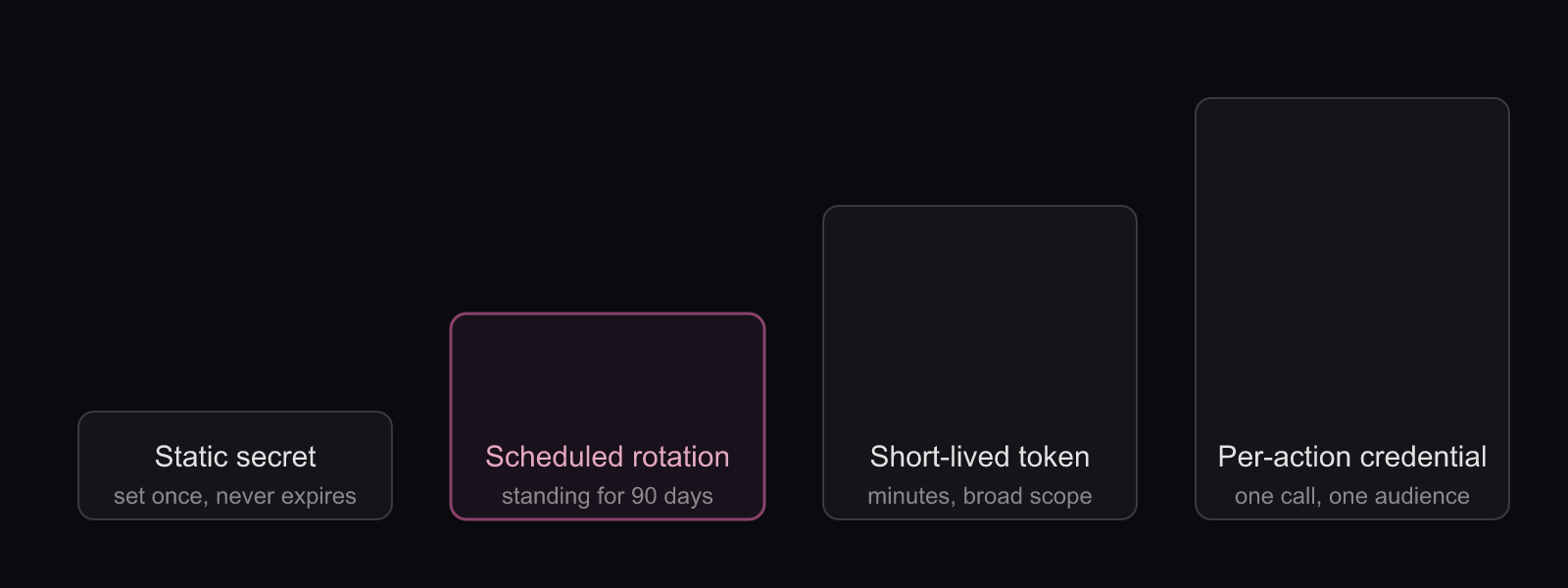
- Static secret. Keys created once and shared by whoever needs them. Nothing expires. Start by finding them: repositories, CI variables, images, configuration files, and the agent tool configurations nobody inventoried.
- Scheduled rotation. The same secrets, changed periodically. This is where most environments actually are. It reduces the lifetime of a leak from forever to one cycle, and it is not the same control as expiry.
- Short lived credentials. Credentials minted per session with real expiry, usually still carrying broad permissions. This is the biggest single risk reduction in the sequence, and the stage where clock sync, refresh handling, and issuer capacity get their real test.
- Per-action credentials. Minted per action, scoped to one audience, bound to the holder, and carrying the delegation chain. This is the target state for anything an AI agent touches.
Sequence the work by blast radius rather than by ease. Production data stores and anything an agent can reach unattended go first; the internal dashboard nobody can pivot from goes last. Run both paths in parallel during cutover, watch the denial logs, and remove the static secret only once the ephemeral path has carried real traffic for a full business cycle.
Where ephemeral credentials fit alongside related controls
Credential lifetime is one control in a set. These are the neighbouring pieces, and what each one owns.
- Step-up authentication decides when to interrupt an agent and put a human back in the approval path. Ephemeral credentials decide what the agent holds between those interruptions.
- Non-human identity covers the identity object itself: what counts as an NHI, how they sprawl, and how to inventory them. Ephemeral credentials are a control you apply to those identities.
- MCP identity covers authentication and authorization specifically for Model Context Protocol servers, where agent tool calls terminate.
- AI agent governance is the wider program: policy, approval, audit, and ownership across the agent estate, with credentials as one enforcement mechanism inside it.
- Agent authorization covers the decision that comes first: whether this agent may take this action at all, and whose authority it is spending when it does.
Frequently asked questions
What are ephemeral credentials?
Ephemeral credentials are credentials minted on demand for a specific caller and purpose, scoped to a narrow set of permissions, and automatically invalid after a short lifetime. Nothing is stored between uses, so there is no durable secret to steal, and no one has to remember to revoke anything.
What is the difference between ephemeral credentials and short lived credentials?
There is no meaningful difference. Short lived credentials is the infrastructure term and ephemeral credentials is the identity term for the same control. Both describe a credential that expires on its own. What actually varies between implementations is the lifetime, how narrowly the credential is scoped, and whether it is bound to its holder.
How long should an ephemeral credential last?
Long enough to complete the work it authorizes, plus a margin for clock skew and retries. In practice that is 60 seconds to 5 minutes for a single agent action, 5 to 15 minutes for a multi-step task, and up to an hour for pooled database connections. Shorter is better until failures appear.
Are ephemeral credentials more secure than rotating a static secret?
Yes, and the difference is larger than it looks. A secret rotated every 90 days is still a standing key for 89 of them. An ephemeral credential is useless minutes after it is issued and covers only one audience, so a stolen one usually buys an attacker nothing at all.
How do AI agents get ephemeral credentials?
The agent proves its own identity to an issuer, the issuer checks policy for the requested action, and a credential is minted that is scoped to that action and carries both the agent and the human who delegated the task. The agent never holds a long-term secret for the systems it calls.
What is OAuth token exchange used for?
Token exchange trades one token for another that is narrower. A service that must call a second service on a caller's behalf exchanges the incoming token for one scoped to that downstream audience, recording the delegation. For agents it prevents a broad token from being forwarded unchanged through a chain of tool calls. Our guide to how OAuth token exchange (RFC 8693) mints the short-lived token walks through the request parameters and the act claim in detail.
Stop issuing standing authority
The security of a credential is set by how long it lives and how much it can do. Rotation improves neither. Expiry and scope improve both, and for AI agents they also make the audit log capable of naming the person behind an action instead of a shared key.
Agen issues every agent its own identity and authorizes each action at runtime, so the credential an agent holds is scoped to the call it is making and traceable to the human who delegated it. See how that works in the identity foundation for every AI agent.
Keep reading
More from AI Agent Identity & Access
AI Agent Identity & Access
Workload Identity Federation: How Trust Replaces Secrets
Workload identity federation lets services and AI agents get short-lived cloud credentials from a configured trust relationship, not a stored secret.
Agen.co·
AI Agent Identity & Access