AI Agent GovernanceGuide
Agentic Risk Map: How to Map and Score AI Agent Risk
An agentic risk map is a reusable framework for inventorying, scoring, and containing AI agent risk. Learn the risk dimensions, scoring rubric, and build steps.
Agen.co
13 min read

An AI agent doesn't click a button and wait. It reads, decides, and acts, often across systems you never explicitly connected it to. That single shift breaks the risk models most security teams already trust. A vulnerability scanner tells you which library has a CVE. It says nothing about an autonomous agent that holds a production database credential, can call any tool in reach, and hands work off to three other agents before a human sees the result. To see what you are scoring against, start from the taxonomy of AI agent attacks.
An agentic risk map closes that gap. It is a reusable framework for inventorying your AI agents, mapping the risk each one carries across a fixed set of dimensions, scoring that risk, and prioritizing what to contain first. This guide gives you the artifact, not just a list of things to worry about: the risk dimensions, a copyable scoring rubric, least-privilege templates by agent type, and a five-step method to map agentic AI risk in your own environment.
What is an agentic risk map?
An agentic risk map is a structured inventory that plots every autonomous AI agent in your environment against the dimensions that actually drive agentic risk: identity, permissions, actions, blast radius, data access, observability, and autonomy. Each agent gets a score per dimension, a total risk tier, and a remediation owner. The map is the artifact; scoring and prioritization are what make it useful.
The word "map" is deliberate. You are not writing a policy document. You are drawing a picture of where autonomous action can reach inside your systems, so you can see the high-risk agents at a glance and shrink their reach on purpose. It sits inside AI agent governance as the operational layer: governance sets the intent, the risk map makes that intent measurable per agent.
Frameworks like the NIST AI Risk Management Framework already treat risk mapping as a named governance function. The agentic risk map is how you run that "Map" function for agents specifically, where the unit of risk is not a model but an actor with credentials.
Why AI agents need their own risk map
Traditional application risk assumes a bounded program: it does what its code says, and its permissions rarely change. Autonomous agents violate every part of that assumption. They plan their own steps, choose which tools to call, and increasingly coordinate with other agents. Mapping that risk is a different exercise, which is why autonomous agent risk mapping has become its own discipline rather than a footnote in your app threat model.
Four properties make agents uniquely hard to reason about:
- Autonomy. An autonomous AI agent decides its own next action. The attack surface is not a fixed set of endpoints; it is the space of everything the agent could plausibly choose to do.
- Broad tool access. Agents reach real systems through tools and connectors, often over the Model Context Protocol (MCP). One over-scoped connection turns a helpful assistant into a lateral-movement path.
- Agent-to-agent chains. In multi-agent systems, one agent delegates to another. A failure or a prompt injection propagates down the chain, and the last agent in line may act with more privilege than the first.
- Non-human identity sprawl. Every agent needs credentials, and those credentials multiply fast. Ungoverned, they become the largest and least-watched identity population in the enterprise.
The data backs the urgency: enterprises are deploying agents faster than they are governing them, and the gap between the two is where incidents live. Our own analysis of that gap is covered in the agentic AI security gap. A risk map is how you close it deliberately instead of hoping detection catches what prevention missed.
The risk dimensions: the axes of your map
A useful map needs fixed axes. These seven dimensions are the columns every agent gets scored against. They map cleanly onto the OWASP agentic threat taxonomy, which organizes agentic risk across agent design, memory, planning and autonomy, tool use, and deployment. We translate that taxonomy into dimensions you can score.
Identity: who the agent is
Every agent is a non-human identity (NHI) with credentials, and it must be governed like one. The risk questions: does the agent have a distinct, attributable identity, or does it share a service account? Are its credentials short-lived and scoped, or long-lived static secrets? Treating agents as first-class identities is the foundation for everything downstream, which is why identity is the house discipline behind a defensible map. Frontegg's identity foundation and MCP identity both go deeper on attributable agent identity.
Permissions and least privilege: what the agent may do
Permissions are where most agentic risk actually accumulates. Agent permissions security is the practice of granting each agent the narrowest set of actions its job requires and nothing more. The common failure is the opposite: an agent inherits a broad role "to be safe," and that role becomes its ceiling for damage. Scope permissions per task, and enforce them at a gateway rather than trusting the agent to self-limit. Our guide to MCP access control covers gateway-enforced scoping in depth.
Actions and tool use: what the agent can reach
Tools are the agent's hands. Each connected tool, API, or MCP server extends what the agent can do and therefore what an attacker can do through it. Map every tool an agent can call and classify it by impact: read-only lookups are low, anything that writes, deletes, pays, or emails is high. The MCP security and MCP security risks guides detail how tool connections become an attack surface.
Blast radius: how far a failure reaches
Agent blast radius is the total damage an agent can cause if it is compromised, hijacked by prompt injection, or simply wrong. It is the load-bearing axis of the whole map, because it converts an abstract worry ("this agent has a lot of access") into a bounded number of systems, records, and downstream agents. An agent with read-only access to one dataset has a small blast radius; an agent that can move money, delete records, or trigger other agents has a large one. Because blast radius deserves its own treatment, we cover measuring and containing it in the dedicated guide to agent blast radius and threat containment.
Data access: what the agent can read and write
Agents that retrieve context, especially through retrieval-augmented generation, can read far more than they should if the data layer is not scoped to the requesting user's entitlements. Map each agent's data reach and whether retrieval respects existing access controls. Our RAG and retrieval security guide covers scoping the retrieval layer.
Observability and auditability: whether you can see what it did
An action you cannot reconstruct is an action you cannot govern. Score each agent on whether every decision and tool call is logged, attributable to that agent's identity, and reviewable. Continuous visibility is the difference between a map that ages into fiction and one that stays true, which is the domain of AI security posture management.
Autonomy level: how much runs without a human
The more an agent acts without human review, the higher the stakes of every other dimension. A suggest-only agent that drafts an email is low autonomy; an agent that sends, purchases, or provisions without a checkpoint is high. Autonomy is the multiplier: the more autonomous the agent, the more its permissions and blast radius matter.
Assemble the dimensions across your agent archetypes and the map takes shape. The grid below is the reusable core of an agentic risk map: rows are the agents you run, columns are the dimensions, and each cell holds a 1 to 5 score.
| Agent archetype | Identity | Permissions | Tool/action reach | Blast radius | Data access | Autonomy |
|---|---|---|---|---|---|---|
| Customer-service agent | Shared account risk | Refunds, account edits | CRM, billing, email | High (touches customers + money) | Customer PII | Medium (some auto-actions) |
| Code assistant | Often a developer's own token | Repo write, CI triggers | Git, package registries, CI/CD | High (supply chain) | Source + secrets | Medium to high |
| Data-analysis agent | Service credential | Warehouse queries | Data warehouse, BI tools | Medium (read-heavy) | Broad analytical data | Low to medium |
| Ops/automation agent | Machine identity | Provision, deploy, delete | Cloud APIs, IaC, infra | Very high (production infra) | Config + secrets | High |
The cells above are typical starting points, not verdicts. The build method turns those qualitative notes into real per-agent scores.
How to build an agentic risk map: five steps
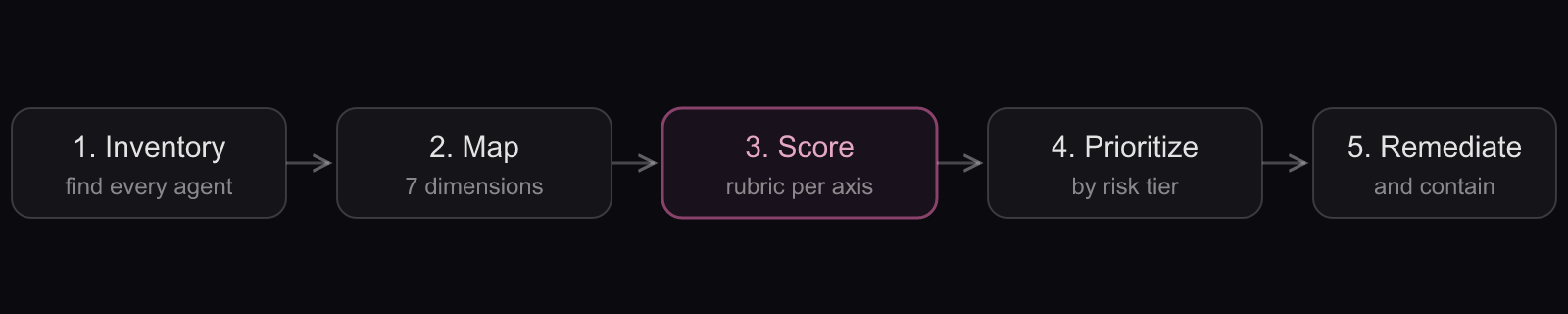
Building the map is a repeatable sequence. You inventory what you have, map each agent across the dimensions, score it, prioritize by tier, then remediate and contain. Run it once to stand the map up, then re-run it on a cadence as your agent fleet changes.
Step 1: Inventory every agent
You cannot map what you cannot see. List every agent running against your systems: sanctioned copilots, home-grown automations, third-party agents, and the shadow ones a developer wired up last quarter. For each, capture its identity, its owner, the tools it can call, and the systems it touches. An incomplete inventory is the single most common reason a risk map fails, because the riskiest agent is usually the one nobody put on the list.
Step 2: Map each agent across the dimensions
Take each inventoried agent and fill in the seven dimensions from the grid above. This is qualitative first: what identity does it use, what can it do, how far does a failure reach. The goal is an honest per-agent picture, not yet a number. Map the reality, including the uncomfortable parts, because a flattering map protects nobody.
Step 3: Score each agent
Scoring is what turns a description into an agentic AI risk assessment you can act on. Rate each dimension 1 to 5, where 1 is tightly controlled and 5 is unbounded. The rubric below keeps scores consistent across agents and across the people doing the scoring.
| Dimension | Score 1 (contained) | Score 3 (moderate) | Score 5 (unbounded) |
|---|---|---|---|
| Identity | Distinct identity, short-lived scoped credentials | Distinct identity, long-lived secret | Shared service account, static key |
| Permissions | Least privilege, per-task scope | Broad role, some unused rights | Admin or wildcard permissions |
| Tool/action reach | Read-only tools | Writes to non-critical systems | Can pay, delete, provision, or email |
| Blast radius | One system, reversible actions | Several systems, recoverable | Production or money, hard to reverse |
| Data access | Scoped to caller entitlements | Broad read, no write | Unfiltered access to sensitive data |
| Observability | Every action logged and attributable | Partial logging | No usable audit trail |
| Autonomy | Suggest-only, human approves | Auto-acts on low-risk tasks | Full autonomy, no checkpoint |
Combine the per-dimension scores into one agent risk score. A simple, defensible formula is to weight blast radius and autonomy most heavily, since they govern how bad a failure gets and how likely it is to happen unsupervised: agent risk = (blast radius + autonomy) × average of the other five dimensions. Use whatever weighting your organization can defend, and apply it identically to every agent.
Step 4: Prioritize by risk tier
Sort the scored agents into tiers so remediation has an order. Tiers turn a spreadsheet into a work queue.
- Tier 1 - Critical: high blast radius and high autonomy. Contain first, this week.
- Tier 2 - High: high blast radius or broad permissions, some human oversight. Contain this quarter.
- Tier 3 - Moderate: scoped reach, mostly reversible actions. Monitor and tighten opportunistically.
- Tier 4 - Low: read-only, suggest-only, small blast radius. Keep on the map, review on cadence.
Step 5: Remediate and contain
Remediation is where the map earns its keep, and the guiding rule is that prevention beats detection. Every point of risk you designed out is a point you never have to catch at runtime. Shrink identity risk with scoped, short-lived credentials. Shrink permissions with least privilege enforced at a gateway. Shrink action risk and blast radius with AI guardrails and human-in-the-loop checkpoints on high-impact actions. Then keep detection as the backstop for what prevention cannot cover. The more you contain up front, the smaller the map you have to watch.
Least-privilege templates by agent archetype
Least privilege is easier to enforce when you start from a template instead of a blank slate. These are conservative defaults for common archetypes. Start here, then tighten to the specific task.
| Archetype | Default permission posture | Human checkpoint | Hard limits |
|---|---|---|---|
| Customer-service agent | Read customer record; propose refunds and edits | Approval above a refund threshold | No bulk actions; no data export; rate-limited |
| Code assistant | Read repo; open pull requests, not merge | Human merge and deploy | No direct main-branch writes; no prod secrets |
| Data-analysis agent | Read-only warehouse, entitlement-scoped | None for reads; approval for exports | No writes; no access to raw PII columns |
| Ops/automation agent | Scoped provisioning in non-prod | Approval for any production change | No delete of stateful resources; no IAM edits |
Enforce these at an access gateway, not inside the agent's prompt. An instruction the agent can reason its way around is a suggestion; a permission the platform refuses to grant is a control.
Agentic risk map vs. threat model vs. NIST AI RMF
An agentic risk map does not replace your existing frameworks; it operationalizes them for agents. Here is where each fits.
| Approach | Unit of analysis | Best for | Relationship to the map |
|---|---|---|---|
| Traditional threat model | A specific system or data flow | Design-time analysis of one application | Feeds the map; too static for autonomous behavior alone |
| NIST AI RMF | Organizational AI risk posture | Governance functions: govern, map, measure, manage | The map executes its "Map" function for agents |
| OWASP agentic taxonomy | Agentic threat categories | Knowing what can go wrong | Supplies the risk dimensions you score against |
| MITRE ATLAS | Adversary tactics against AI | Understanding attacker techniques | Informs the threat scenarios behind blast radius |
| Agentic risk map | The individual agent | Prioritizing which agents to contain first | The applied artifact that ties the others together |
MITRE ATLAS catalogs the real-world tactics adversaries use against AI systems, which is what makes a blast-radius scenario concrete rather than hypothetical. The Cloud Security Alliance frames agentic governance around five pillars, inventory, identity, least privilege, observability, and continuous compliance, and the risk map is where those pillars become per-agent measurements. OWASP's Top 10 for Agentic Applications gives you the first peer-reviewed taxonomy to anchor those dimensions. For the broader program these frameworks live inside, see our guides to AI risk management and AI governance.
Best practices and common pitfalls
The teams that get durable value from an agentic risk map tend to avoid the same traps.
- Don't treat agents as generic service accounts. A shared account erases attribution and inflates blast radius. Give every agent a distinct, governed identity. See how to govern AI agents across enterprise apps.
- Don't map once and file it. Agents, tools, and permissions change weekly. A static map is fiction within a month; re-run the method on a cadence and on every material change.
- Close the policy-versus-runtime gap. A policy that says "least privilege" but is not enforced at runtime is a wish. Enforce scope at the access layer so the map reflects reality, not intent.
- Weight blast radius, don't average it away. A flat average buries the agents that can do real damage. Let blast radius and autonomy dominate the score.
- Put the shadow agents on the map. The agent nobody sanctioned is the one most likely to hold the worst credential. Inventory aggressively.
Frequently asked questions
What is an agentic risk map?
An agentic risk map is a reusable framework that inventories your AI agents and scores each one across fixed risk dimensions: identity, permissions, actions, blast radius, data access, observability, and autonomy. It produces a per-agent risk tier so teams can prioritize which autonomous agents to contain first.
What is agent blast radius?
Agent blast radius is the total damage an AI agent can cause if it is compromised, manipulated, or simply wrong. It counts the systems, data, and downstream agents its permissions can reach. A read-only agent has a small blast radius; one that can move money or delete records has a large one.
How do you assess the risk of an AI agent?
Score the agent across seven dimensions on a 1 to 5 scale, then combine them into one risk score that weights blast radius and autonomy most heavily. Sort agents into tiers by that score. This agentic AI risk assessment turns a qualitative worry into a prioritized, defensible work queue.
What are the risk dimensions of agentic AI?
The seven dimensions are identity (non-human identity and credentials), permissions and least privilege, actions and tool use, blast radius, data access, observability and auditability, and autonomy level. Together they form the columns of the map, and each agent is scored against all of them.
How is an agentic risk map different from a threat model?
A threat model analyzes one system or data flow at design time. An agentic risk map takes the individual agent as its unit and scores its live, autonomous reach across your environment. Threat models feed the map, but they are too static to capture behavior an agent chooses at runtime.
How often should you update an agentic risk map?
Re-run the method on a regular cadence, monthly for fast-moving fleets, and immediately whenever an agent gains new tools, permissions, or autonomy. Agent environments change constantly, so a map that is not refreshed quickly drifts into fiction and stops reflecting real risk.
Turn your risk map into enforcement
An agentic risk map tells you exactly where autonomous action can reach and which agents to contain first. But a map you cannot enforce is just a well-organized to-do list. The value shows up when least privilege, scoped identity, guardrails, and blast-radius containment become controls the platform enforces, not policies you hope agents respect.
That is where agen.co comes in. Treating agents as first-class identities, scoping their permissions at the access layer, and containing blast radius is exactly what our Risk Prevention capabilities and identity foundation are built to do. Build the map, then shrink it: start with your Tier 1 agents and give each one an attributable identity and least-privilege scope.
Keep reading