What Is Agentic AI? A Complete Guide to Autonomous AI Systems
Agentic AI plans, decides, and acts on goals autonomously. Learn how it works, how it differs from generative AI, real examples, and how to govern it safely.
Agen.co
/22 min read

Agentic AI is software that pursues a goal on its own, perceiving its environment, reasoning about what to do, planning a sequence of steps, and taking action through tools and systems with limited human supervision. Where a chatbot answers a question, an agentic system completes the work behind it.
This guide is written for the engineering, platform, security, and product leaders deciding how to adopt agentic AI safely. It explains what agentic AI is in plain language, how it works, how it differs from generative AI and from "AI agents", where it is already deployed, and the part most explainers skip: what changes about security and governance the moment your software starts acting instead of just answering.
TL;DR: Agentic AI is AI that acts, not just answers. It wraps a reasoning model (usually a large language model) in a loop of perceive, reason, plan, act, observe, gives it memory and tools, and points it at a goal. The capability is increasingly easy to build. The hard part is control: every agent that can take real actions becomes a non-human identity that must be authenticated, scoped to least privilege, audited, and governed.
What is agentic AI?
Agentic AI refers to AI systems that autonomously make decisions and take actions to achieve a goal, with minimal human oversight. Rather than producing one output for one prompt, an agentic system receives a desired outcome and works out the steps to reach it, calling tools, querying data, invoking APIs, and adapting as conditions change.
Four traits separate agentic AI from the AI that came before it. For the engineering view of how those traits are assembled, see the AI agent architecture guide.
| Trait | What it means in practice | What it replaces |
|---|---|---|
| Autonomy | The system decides its own next step instead of waiting for the user to specify each one. | Turn-by-turn prompting |
| Goal-orientation | It works toward an objective, breaking a complex goal into ordered sub-tasks. | Single-shot requests |
| Statefulness | It carries context across many steps and sessions, not just one turn. | Stateless completions |
| Tool use and action | It reaches outside the model into real systems to do things, not only describe them. | Text output a human then acts on |
A note on language, because the terms get used interchangeably and the difference matters later. "Agentic AI" is the broad design paradigm: software built to act with agency. "An AI agent" is a single instance of that paradigm, a discrete entity with a goal, memory, and a set of tools. If you want the entity-level view, including how one agent is wired to its tools, start with our guide to what an AI agent is. This page stays at the paradigm level, because the questions that decide an adoption program change once you are running more than one.
Why agentic AI matters now
For most of the recent AI wave the dominant pattern was reactive. You prompt a model, it returns text, an image, or code, and a human decides what to do with it. Generative AI can write an email. It cannot decide who should receive it, look up the recipient, or send it. Agentic AI closes that gap. Pointed at "schedule the follow-ups for everyone who did not reply", it reads the inbox, identifies the non-responders, drafts messages, and sends them.
That shift, from generating content to completing work, is why agentic AI moved to the center of enterprise AI strategy inside a single planning cycle. MIT Sloan draws the line at decision-making: generative AI automates the creation of text, images, and video, while agents go further and act. It automates multi-step knowledge work that rule-based automation could never handle, because an agent reasons through ambiguity instead of breaking on it.
The adoption curve is steeper than the governance curve, and that gap is the story of the moment. Research published by MIT Sloan Management Review and Boston Consulting Group in November 2025 found 35% of surveyed organizations already deploying agentic AI and another 44% planning to, and summarized the result as a tidal wave of adoption against a trickle of strategy.
The same property that makes agentic AI valuable makes it risky. The moment software takes actions in your systems, the question stops being "is the answer good?" and becomes "should this thing have been allowed to do that?" Hold onto that idea. It shapes everything later in this guide.
How does agentic AI work? The agentic loop
Under the hood, an agentic system runs a continuous loop. A reasoning model sits at the center as the brain, and the loop gives it a body and a memory.
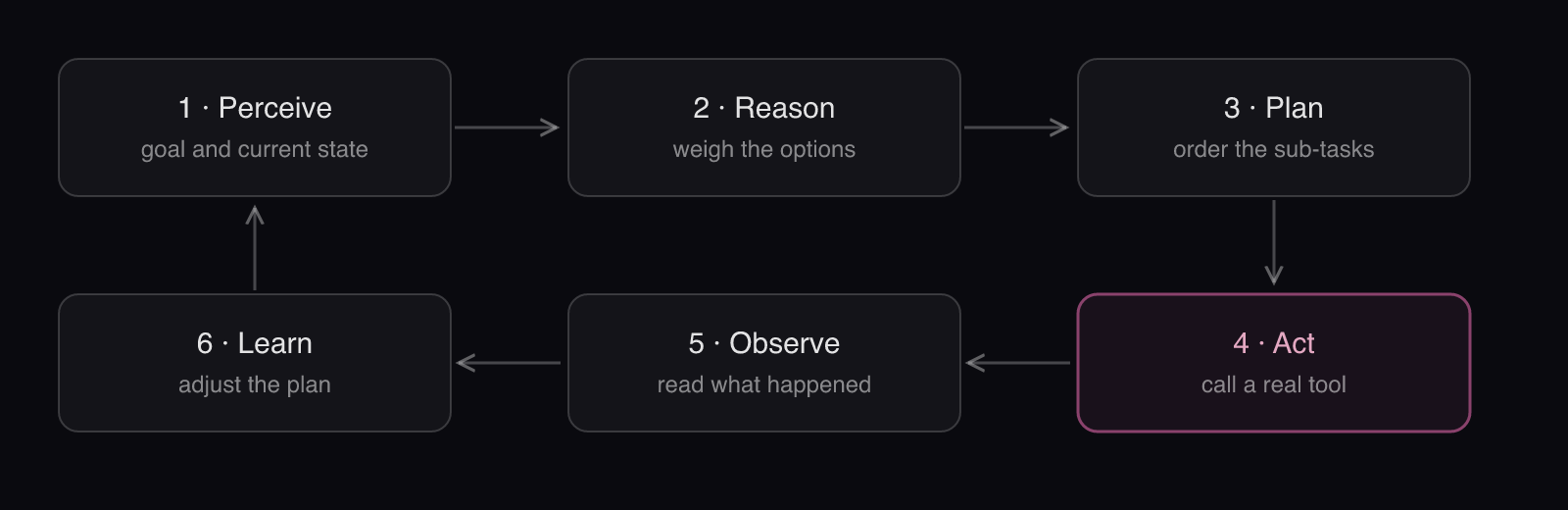
- Perceive - the agent gathers and interprets inputs: the goal, the current state of the world, data from APIs, files, search results, or the outcome of its last action.
- Reason - it interprets what it perceived, evaluates options, and decides what matters for the goal.
- Plan - it breaks the goal into an ordered set of sub-tasks and chooses the next step.
- Act - it executes that step by calling a tool: running code, querying a database, hitting an API, sending a message, or handing work to another agent.
- Observe - it reads the result of the action and feeds it back into perception.
- Learn and reflect - it adjusts its plan based on what happened, then repeats until the goal is met or it hits a stopping condition.
A flight-booking task, step by step
Suppose you ask an agent to "find the three cheapest flights from New York to Lisbon next month and put them in a spreadsheet". A generative model would describe how to do that. An agentic system instead perceives the goal, plans to search a flights API, acts by calling it with date ranges, observes the results, reasons that one airport returned no data and re-queries an alternate, then acts again to write the rows into a spreadsheet through another tool, looping until the spreadsheet exists. No human picked each step.
The autonomy spectrum
That walkthrough makes autonomy sound binary. It is not. Autonomy is a dial, and where you set it is the single most consequential design decision in an agentic system.
At the low end, an agent proposes and a human approves every action, which is slow but fully reviewable. In the middle, the agent acts freely inside a bounded scope and escalates anything outside it, which is where most production deployments sit. At the high end, the agent sets its own sub-goals and acts without checkpoints, which is where the governance questions in this guide stop being optional. Each notch up trades review for speed, and buys blast radius with it. Our guide to autonomous AI agents and the levels of autonomy works through each level and what it takes to deploy safely at each one.
Core components of an agentic AI system
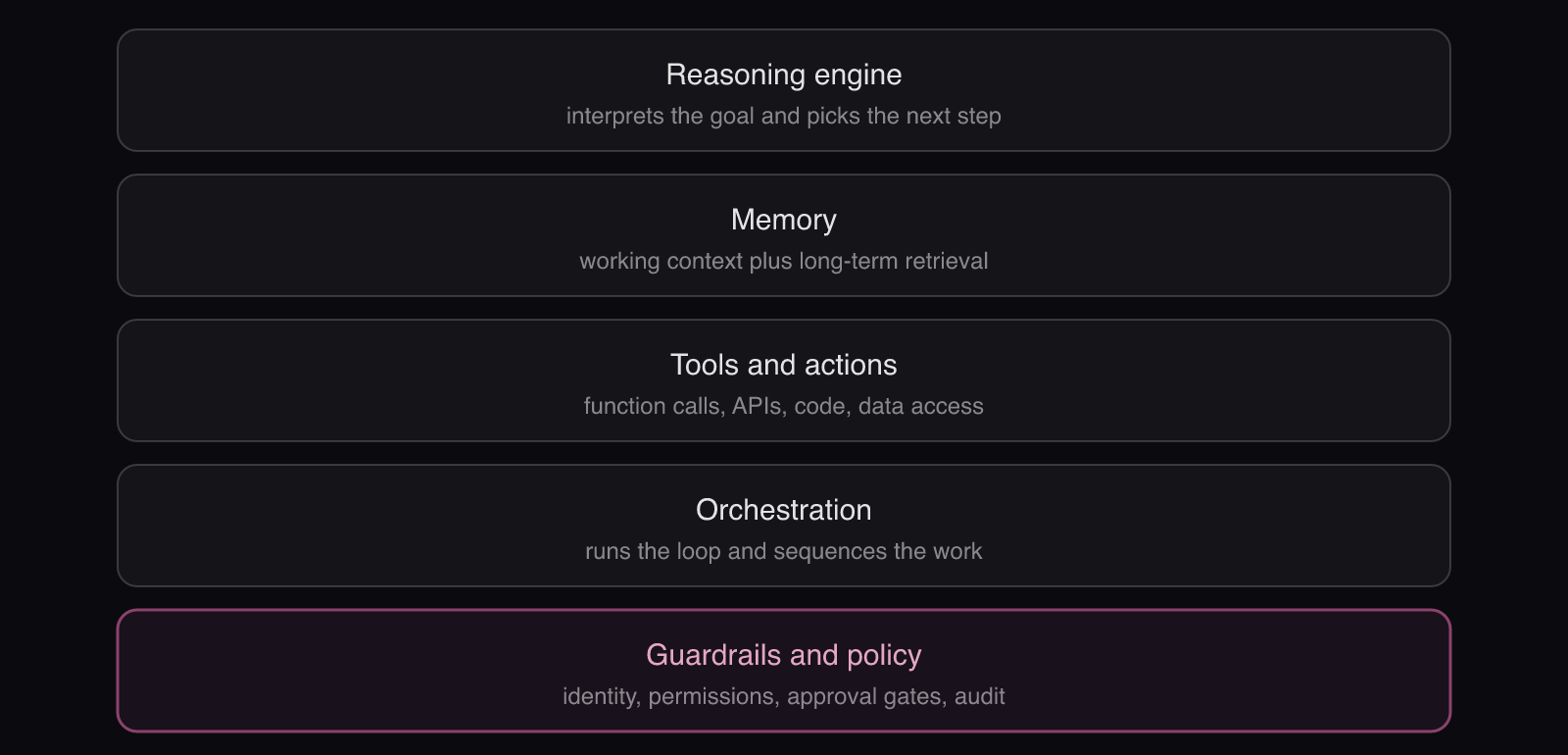
The loop above needs machinery underneath it. Most agentic systems are assembled from the same five building blocks regardless of framework, and they stack: nothing above the guardrail layer is safe if that layer is missing.
| Component | Role |
|---|---|
| Reasoning engine (model) | Usually a large language model. The brain that interprets goals, reasons, and decides the next step. |
| Memory | Short-term working memory (the context window) plus long-term memory, often a vector database with retrieval-augmented generation (RAG), so the agent keeps continuity across long tasks. When the agent chooses its own retrieval strategy rather than following a fixed pipeline, that pattern is called agentic RAG. |
| Tools and actions | The agent's hands: function calling, API calls, code execution, database access, and standards like the Model Context Protocol (MCP) that let agents connect to external tools and data in a uniform way. The MCP specification defines that interface as an open standard. |
| Orchestration | The control logic that runs the loop, sequences sub-tasks, and, in multi-agent setups, coordinates several agents. An orchestrator is the component that assigns and sequences work across agents. |
| Guardrails and policy | The constraints that decide what the agent is allowed to do: permissions, approval gates, validation, and the identity it acts under. This is where security lives. |
Agentic AI vs generative AI vs AI agents
Those components explain what an agentic system is made of. They do not explain why three different terms are used for what sounds like the same thing. These get confused constantly, so here is the clean version, with rule-based automation included because that is the comparison most enterprise readers are actually making.
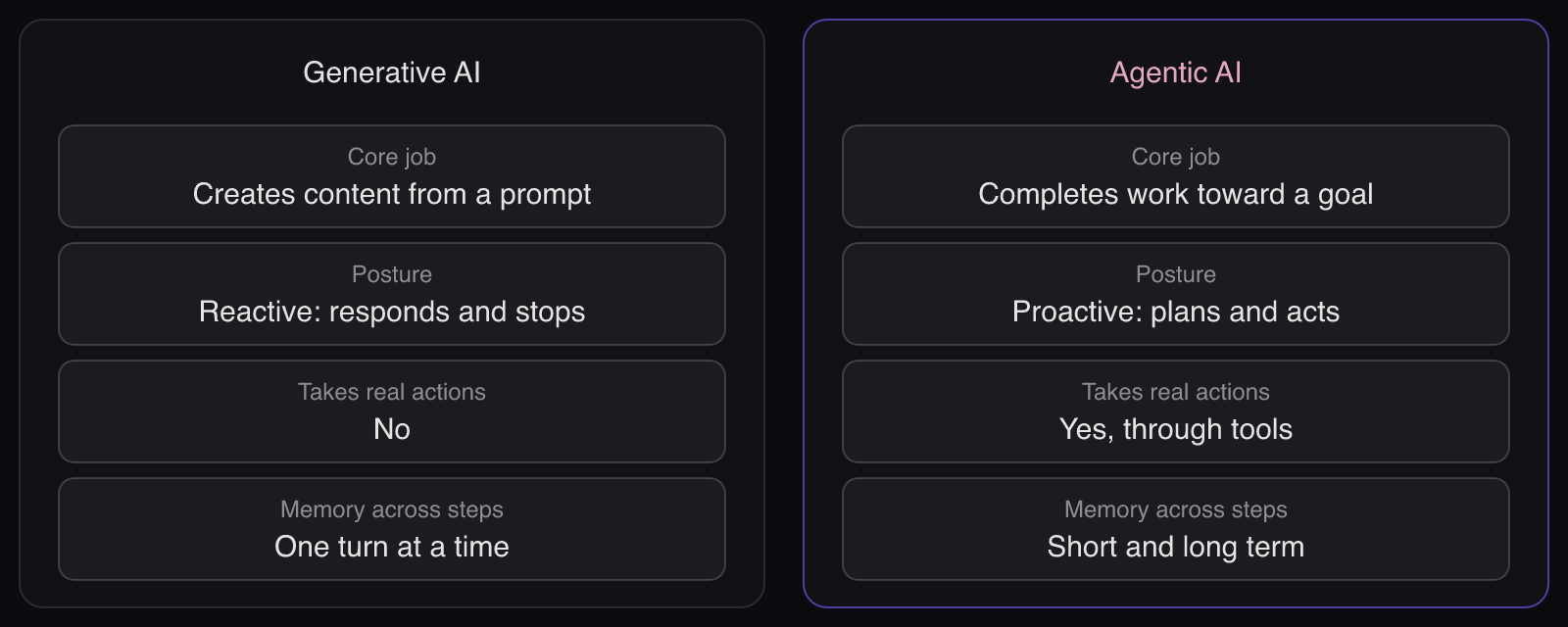
| Generative AI | AI agent | Agentic AI | RPA | |
|---|---|---|---|---|
| Core job | Create content from a prompt | A single autonomous entity pursuing a goal with tools | The broader paradigm of goal-directed, acting AI, often many agents | Repeat a recorded sequence of clicks and keystrokes |
| Posture | Reactive, responds | Proactive, acts | Proactive, orchestrates work | Scheduled, replays |
| Takes real actions? | No | Yes | Yes | Yes |
| Handles the unexpected | Not applicable | Reasons and retries | Reroutes across agents and tools | Fails and halts |
| Example | Writes an email | An agent that reads, drafts, and sends the email | A system of agents running the whole follow-up campaign | Copies a row from a report into a form |
Agentic AI vs generative AI
Generative AI is reactive. It creates an output (text, image, code, audio) in response to a request and stops. Agentic AI is proactive: it uses a generative model as a component, then adds memory, tools, and a planning loop so it can pursue a goal and finish the work. Put simply, generative AI produces and agentic AI achieves. Generative AI can be part of an agentic system, but it never acts on its own.
Agentic AI vs AI agents (and autonomous agents)
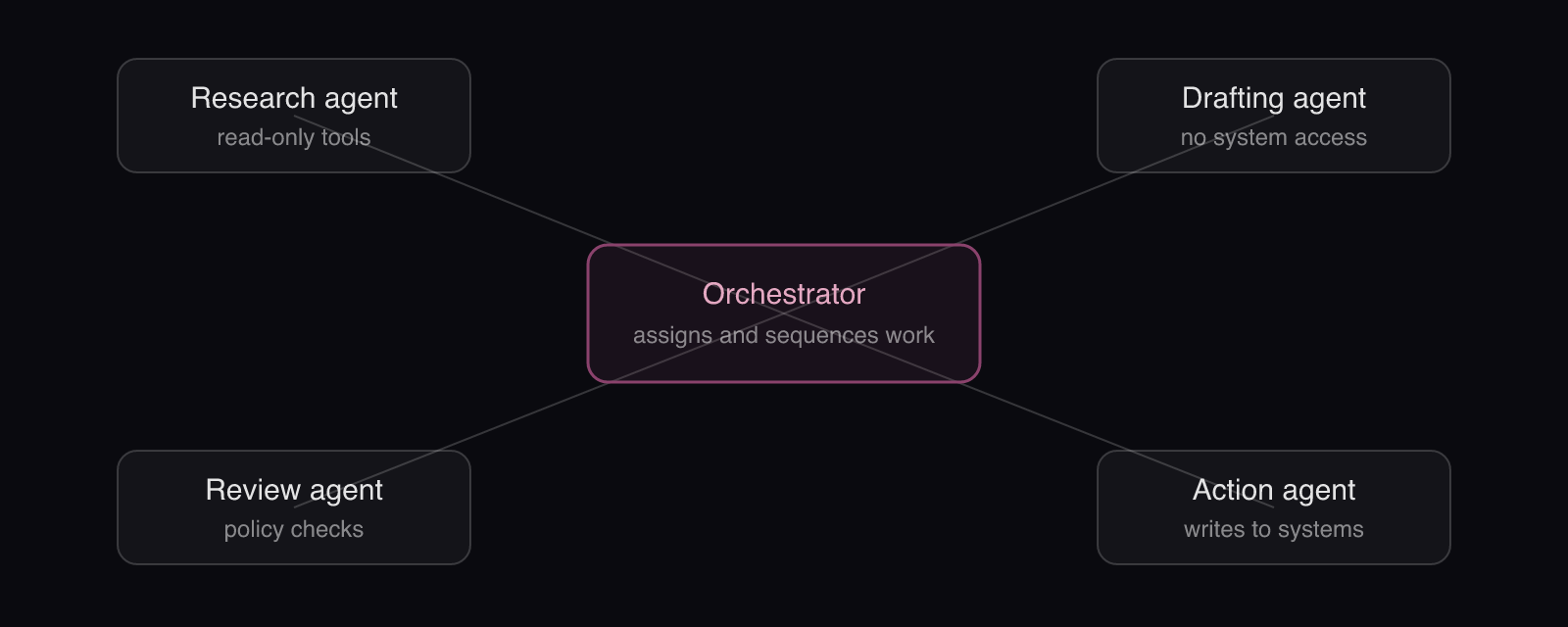
An "AI agent" is a single agentic entity. "Agentic AI" is the umbrella concept, and increasingly implies multi-agent systems where specialized agents collaborate under an orchestrator: one researches, one writes, one reviews. For the dedicated explainer, see multi-agent systems in AI. "Autonomous agents" emphasize degree of independence, which is the spectrum covered above and in depth in autonomous AI agents.
There is also a formal taxonomy of agent types, from simple reflex agents through learning agents, that predates the current wave by decades and still explains a lot about how one agent behaves. It belongs to the entity-level view rather than this one, and it is covered in full in our guide to AI agents. The practical test for which page you want: if the answer changes depending on how many agents you run, it is here. If it changes depending on what one agent is made of, it is there.
Agentic AI vs RPA and traditional automation
Robotic process automation (RPA) and scripts follow fixed, predefined rules. They are fast, cheap, and completely predictable, which is exactly why they break the moment the situation deviates from what was recorded. A renamed field, a new dialog, an unexpected error state, and the run halts.
Agentic AI reasons through novel or ambiguous situations and adapts its plan, which is why it reaches work RPA never could. The trade is predictability. An RPA bot that fails, fails loudly and stops. An agent that misreads a situation keeps going, and each subsequent action compounds the first mistake. That is the governance stakes in one sentence, and it is why the controls in this guide are runtime controls rather than pre-approval checklists.
Copilots sit between the two. They suggest and a human commits, so they carry an agent's flexibility with a script's blast radius. Many organizations shipping "agents" are shipping copilots, and the distinction matters the moment the approval step is removed.
Agentic AI architecture: single-agent, multi-agent, and orchestration
Once you accept that an agentic system may involve more than one agent, the architecture question becomes real. Agentic AI architecture ranges from a single agent calling a few tools to multi-agent systems where a coordinator distributes work across specialists.
| Pattern | How it works | Use when | Governance cost |
|---|---|---|---|
| Single agent | One agent, one loop, one toolset. | The task is bounded and the tools are few. | Low. One identity, one audit trail. |
| Orchestrator and workers | A coordinator decomposes the goal and assigns sub-tasks to specialized agents. | The goal splits cleanly into different skills or permission levels. | Medium. Each worker needs its own scoped identity. |
| Peer collaboration | Agents negotiate directly without a central coordinator. | Rarely, in research settings. Hard to predict in production. | High. Traces branch and blame is difficult to assign. |
| ReAct and planning loops | Reasoning steps interleave with actions inside a single agent. | Any agent that must adapt mid-task. Usually a layer inside the patterns above. | Low on its own, but it multiplies tool calls. |
The architectural choice is a governance choice wearing different clothes. Every agent you add is another identity to scope and another trace to correlate, which is why multi-agent systems are harder to operate than their capability gains suggest.
Agentic AI frameworks and platforms
Those patterns are rarely built from scratch. A layer of agentic AI frameworks now implements the loop, the orchestration, and the tool plumbing, so teams argue about topology rather than about retry logic.
| Category | What it gives you | What you still own |
|---|---|---|
| Graph and state-machine orchestrators | Explicit control flow, checkpointing, and replayable state for long-running agents. | Every permission decision at each node. |
| Conversation-based multi-agent frameworks | Agents that coordinate by message-passing, with roles and turn-taking handled for you. | Termination conditions and cost ceilings. |
| Role and crew frameworks | Fast assembly of specialist agents around a shared goal, with minimal wiring. | Observability, which is thinnest where setup is easiest. |
| Vendor agent platforms | Hosted runtime, managed tool catalogs, and built-in tracing. | Portability, and the identity model, which is usually the platform's rather than yours. |
| Tool-connection standards | A uniform interface between any agent and any tool or data source, notably MCP. | Authentication and authorization at the gateway. |
The category that matters most for this guide is the last one. Model Context Protocol (MCP) has become the common way for agents to reach tools and data, which makes it the natural place to enforce policy rather than doing it framework by framework. Its specification and reference implementations are maintained in the open, which is a large part of why competing frameworks converged on it rather than each shipping a bespoke tool interface. If you are comparing how agents talk to tools against how they talk to each other, see our breakdown of MCP vs A2A architectures. For build-level mechanics, including function calling and per-agent tool wiring, our guide to AI agents goes deeper than this page needs to.
Framework choice matters less than teams expect. Every one of them produces an agent that needs an identity, a permission scope, and an audit trail, and none of them supplies those for your environment.
Agentic AI examples and use cases
With the frameworks commoditized, the interesting question is what organizations actually run. Agentic AI applications are in production at roughly a third of surveyed organizations, spread across knowledge work, and the pattern is consistent: the successful deployments are narrow, measured, and permissioned, not general-purpose.
- Software engineering - coding agents that read a codebase, write and run code, fix failing tests, and open pull requests. This is the most mature category, with review gates built into the existing pull-request workflow rather than bolted on.
- Customer support - agents that resolve a ticket end to end: look up the account, process a refund, update the record, and reply. Deployments typically cap the refund value an agent may issue without escalation, which is a permission control, not a model control.
- Financial services operations - agents that reconcile transactions, assemble case files for review, and draft regulatory filings, with a human signing the output. Large banks and retailers have described work along exactly these lines, in fraud detection, loan approval, compliance, and merchandise planning, though MIT Sloan characterizes most of it as exploratory rather than fully autonomous.
- Research and analysis - agents that gather sources, synthesize findings, and produce a report with citations a human can check.
- IT and security operations - agents that triage alerts, enrich incidents, and execute remediation steps. Read-only enrichment is common; automated remediation is where organizations slow down, and correctly so.
- Business process automation - agents running multi-step workflows across CRM, finance, and internal tools that were too variable for rule-based RPA.
The through-line: in every mature deployment, the agent's scope is defined by what it is permitted to touch rather than by what it is capable of doing.
Benefits of agentic AI
Those deployments exist because the payoff is real when the scope is right. Four benefits do most of the work.
- Autonomy at scale - completes multi-step work without a human driving each step.
- Always-on execution - runs continuously across systems and time zones.
- Adaptability - handles ambiguity and recovers from failures that would break a rigid script.
- Orchestration - coordinates tools, data, and other agents to handle objectives no single tool covers.
What the ROI data actually shows
Those benefits are real and they are not free, and any guide that stops at the list above is selling rather than explaining. The honest picture from the first full cycle of enterprise deployments is a wide gap between pilots that work and programs that pay.
Gartner forecast in June 2025 that more than 40% of agentic AI projects will be cancelled before the end of 2027, citing escalating costs, unclear business value, and inadequate risk controls rather than model capability. Research on enterprise deployments points the same way. MIT Sloan reports that 80% of the work in these programs goes to data engineering, stakeholder alignment, governance, and workflow integration, not to model tuning, and organizations that budgeted for the latter underestimate the former by a wide margin.
None of that argues against adoption. It argues for scoping the first deployment where the value is measurable and the blast radius is small, which is exactly what the best practices below describe.
Risks and challenges of agentic AI
Cost overruns are the recoverable failure mode. The rest are not. Autonomy is the risk, because an agent acts, so a single bad decision becomes a chain of real-world actions before a human notices.
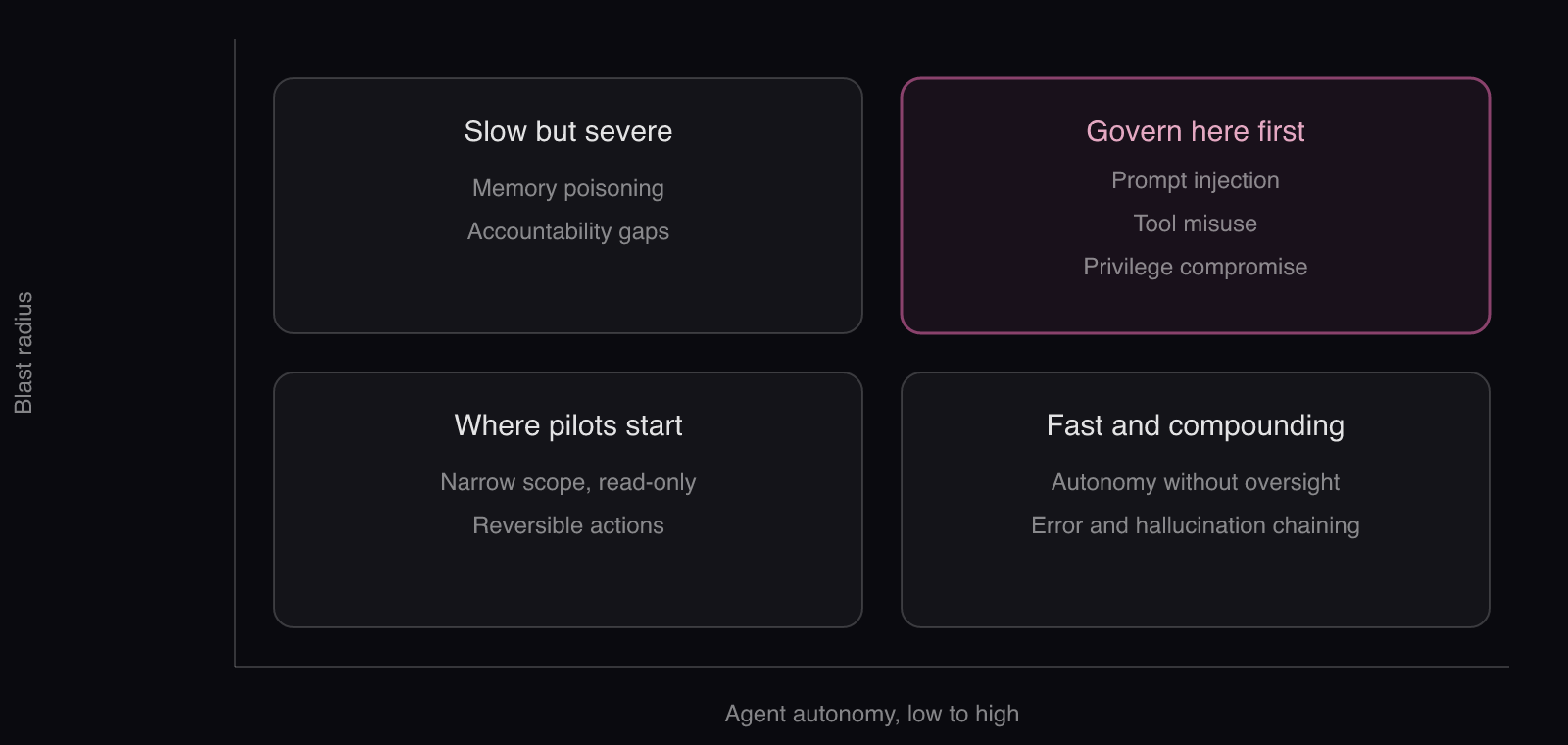
The leading challenges, in the order they tend to bite:
- Autonomy without oversight - agents acting beyond their intended scope.
- Error and hallucination chaining - a wrong assumption early in the loop compounds across every subsequent action.
- Tool misuse - an agent tricked or mis-prompted into abusing the system access it was granted.
- Prompt injection - malicious instructions hidden in data the agent reads, hijacking its behavior.
- Memory poisoning - corrupting an agent's persistent memory so every future decision is compromised.
- Privilege compromise - an agent exploited to escalate access beyond its intended permissions.
- Accountability gaps - when an autonomous system acts, who is responsible, and can you reconstruct what it did?
These are not hypothetical categories. The OWASP Top 10 for Agentic Applications, published by the OWASP Gen AI Security Project in December 2025, catalogues them as the primary threat classes for agentic systems, ranking memory poisoning, tool misuse, and privilege compromise among the most serious, and it treats non-human identities as a first-class part of the attack surface rather than an afterthought. The broader model-layer risks that feed into these are catalogued in the OWASP Top 10 for LLM applications. On the offensive side, MITRE ATLAS has added agent tool-ecosystem techniques covering tool poisoning and agent escape, which is a useful signal that these attacks are now observed rather than theorized.
Field reporting matches the taxonomy. In a Cloud Security Alliance study published in April 2026, 53% of the 445 IT and security professionals surveyed said their AI agents had exceeded their intended permissions, and only 16% were confident they could detect agent-specific threats at all. The gap is not capability. It is detection. We unpack what the data says in our analysis of the agentic AI security gap.
Securing and governing agentic AI: the identity problem
Every risk above shares a root cause, and naming it is the difference between patching symptoms and fixing the category. The moment an agent can take actions in your systems, it stops being a feature and becomes an actor: a non-human identity (NHI), meaning any credentialed actor in your environment that is not a person, operating alongside service accounts, API keys, and delegated permissions. Treating agentic security as a model problem misses this entirely. It is an identity and authorization problem. Our guide to non-human identity covers how these identities are inventoried and controlled across an enterprise estate.
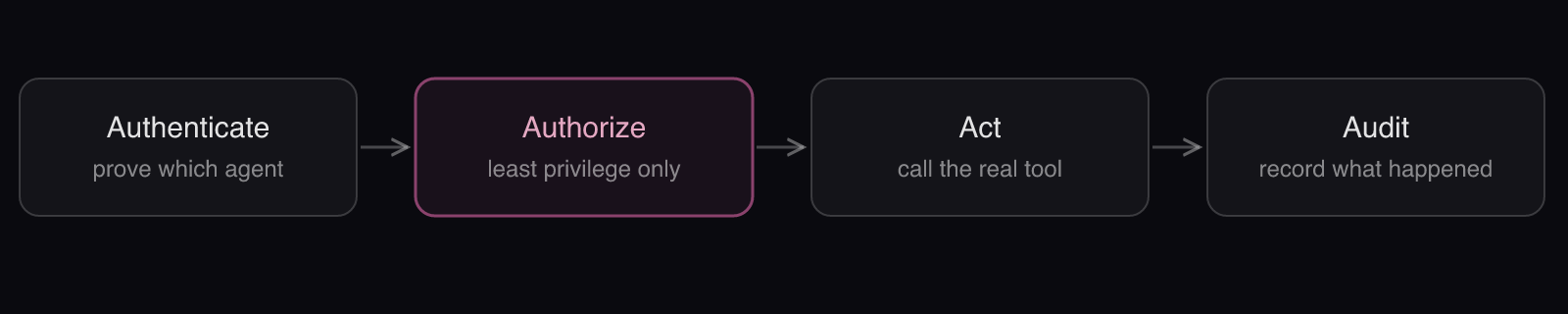
Governing agentic AI means answering four questions for every agent.
- Authentication - what identity does this agent act under, and can you prove it is who it claims to be on every call? For MCP-based agents specifically, see MCP authentication.
- Authorization - is it scoped to least privilege, able to touch only the data and tools its task requires and nothing more? This is where access control for AI agents comes in, and the practical starting point is mapping each agent action to an explicit scope rather than issuing one broad credential and hoping.
- Auditability - can you reconstruct every action it took, with which credentials, and why?
- Governance at scale - as agents multiply and chain together, can you set and enforce policy across all of them, with humans in the loop where the stakes are high? Our guide to AI agent governance covers the operating model.
Neutral authorities have converged on this view faster than most enterprise programs have. On 17 February 2026, NIST launched an AI Agent Standards Initiative with foundational security and identity research as one of its three pillars, which moves this from vendor opinion to standards-track work. The NIST AI Risk Management Framework sets the surrounding governance and control expectations, and NIST publishes the framework and its companion playbook openly. The Cloud Security Alliance published an Agentic Trust Framework applying zero-trust principles to autonomous agents in February 2026, and the OWASP Non-Human Identities Top 10 maps the identity-layer attack surface directly.
The common thread across all four is that agentic systems demand runtime controls and continuous evaluation. Not trust by default, and not a one-time certification, because agents change behavior after deployment and operate across system boundaries. For the threats specific to the tools layer, see our guide to MCP security risks.
This is the difference between an agentic AI experiment and a production-ready agentic AI program. Not how capable the agent is, but how well its identity, permissions, and actions are governed. Governing AI agents across your enterprise apps is the work that turns capability into something you can safely operate.
How to evaluate and monitor agentic AI in production
Identity and authorization decide what an agent may do. They say nothing about whether it is doing it well, and that is the gap most agentic programs discover after launch. An agent is non-deterministic: the same input can produce a different path tomorrow, so the traditional test-then-ship model does not hold. Evaluation becomes a running process rather than a release gate.
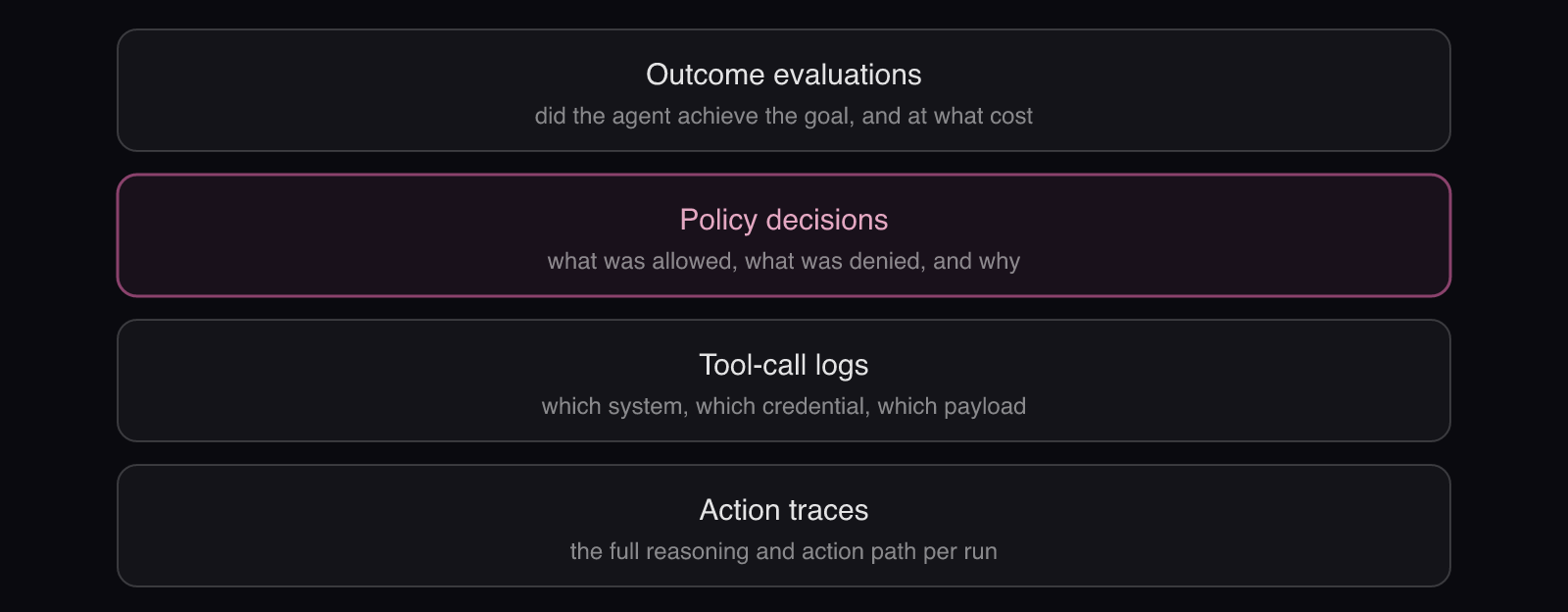
Four layers of instrumentation, each answering a question the layer below cannot:
- Action traces - the complete reasoning and action path for every run, so a bad outcome can be replayed step by step rather than guessed at.
- Tool-call logs - which system the agent touched, under which credential, with what payload. This is the layer that turns an incident into a scoped investigation instead of a full credential rotation.
- Policy decisions - what was allowed, what was denied, and against which rule. Denials are the most useful signal on this list, because a rising denial rate means an agent's scope no longer matches its task.
- Outcome evaluations - did the run achieve the goal, at what token and tool cost, and how does that compare with last week. Score a fixed scenario suite on every model or prompt change, because the alternative is discovering the regression from a user.
The open question in most programs is not which of these to run but who owns the result. Evaluation that belongs to nobody degrades into a dashboard nobody reads, so name an owner for the scenario suite and set the passing threshold before launch, not after the first incident forces one.
Best practices for adopting agentic AI
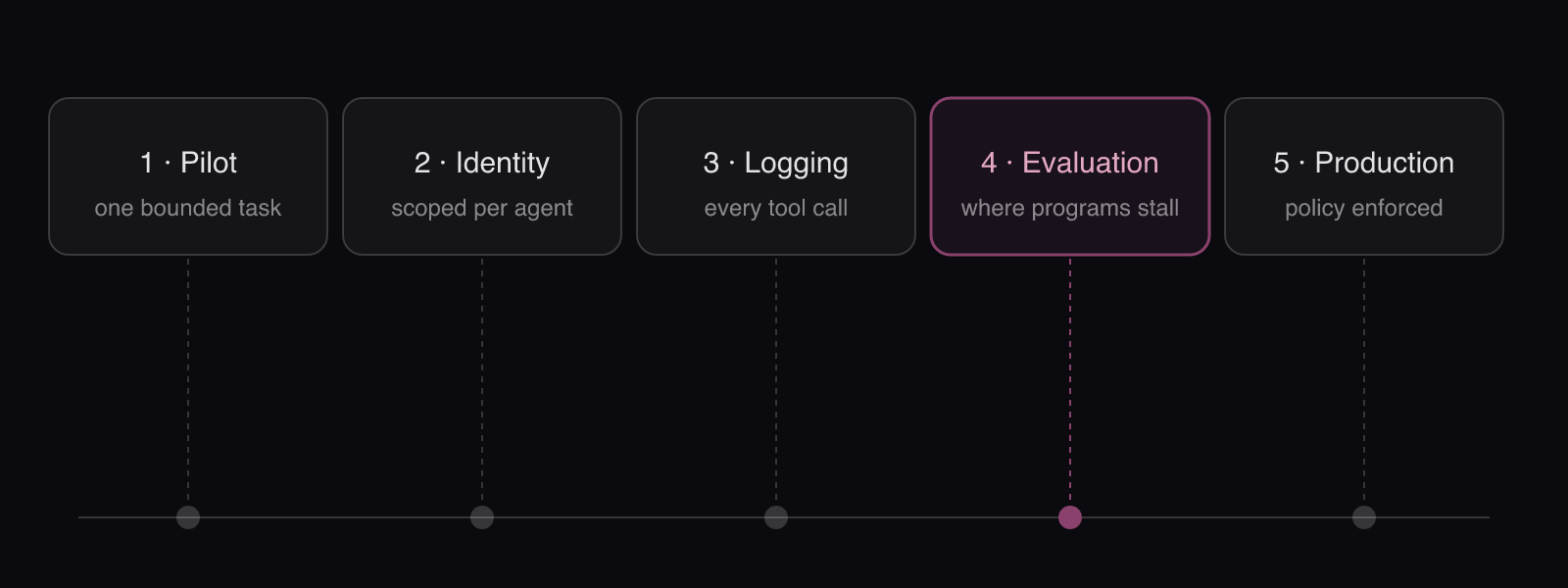
Those controls are cheap to add early and expensive to retrofit, which is the argument for a deliberate adoption sequence rather than a pilot that quietly becomes production. Six practices, in the order they pay off.
| Practice | What it looks like when done | Do it before |
|---|---|---|
| Start narrow | One well-bounded task with a measurable outcome and reversible actions. | Any scope expansion |
| Give each agent its own scoped identity | Per-agent credentials with least-privilege permissions. Never a broad service account shared across agents. | The first production tool call |
| Keep humans in the loop for high-impact actions | Approval gates on anything irreversible, financial, or externally visible. | Removing the pilot's manual review |
| Log everything | Every action, tool call, and credential captured and correlated to one run. | The first incident, because afterwards is too late |
| Evaluate continuously | A scenario suite including adversarial cases, run on every model and prompt change. | Scaling past one agent |
| Plan for failure | Kill switches, rate limits, and rollback paths that an on-call engineer can use at 3am. | Go-live |
One practice deserves emphasis because it is the one most programs get backwards. The hard part of an agentic deployment is rarely the model. It is making the surrounding systems queryable, the tools well-described, and the permissions explicit. Teams that staff this as a data and platform engineering effort ship; teams that staff it as a model-tuning effort stall at stage four. Align the whole sequence against the NIST AI Risk Management Framework rather than inventing one, and the governance review at stage five becomes a conversation instead of a rebuild.
Frequently asked questions
Is agentic AI the same as AGI?
No. Agentic AI describes software that pursues a defined goal using reasoning, memory, and tools within a bounded scope. Artificial general intelligence describes a hypothetical system matching human capability across any domain. An agentic system that books flights cannot suddenly do anything else, and no current agentic deployment approaches general intelligence.
Can agentic AI work without a large language model?
Yes, though it is uncommon today. The agentic loop needs a reasoning component that can decompose a goal and choose a next step. Classical planners, reinforcement-learning policies, and rule engines can fill that role. Large language models dominate because they handle ambiguous, natural-language goals that older planners could not parse.
What does it cost to run an agentic AI system?
Costs scale with loop iterations, not with users. Every perceive-reason-plan-act cycle spends model tokens, and a retry after a failed tool call spends them again. A single agent task commonly costs several times a comparable chatbot answer. Tool calls, vector storage, and observability infrastructure add to the model bill.
How do you test an agentic AI system before trusting it?
Run it against a fixed scenario suite in a sandbox where tool calls hit mocks rather than production systems. Score whether the goal was reached, which path it took, and what it touched. Add adversarial cases for prompt injection and tool misuse, then require a passing run before any credential is issued.
What is agentic RAG?
Agentic RAG is retrieval-augmented generation where the agent decides retrieval strategy instead of following a fixed pipeline. It chooses which sources to query, judges whether results answer the question, and re-queries or switches sources when they do not. Retrieval becomes an action inside the loop rather than a preprocessing step.
Who is liable when an agentic AI system makes a mistake?
Liability currently rests with the deploying organization, not the model vendor or the agent. Most vendor terms disclaim responsibility for downstream actions. That makes audit trails a legal instrument as well as a security control: without a record of which identity acted and under what authorization, an organization cannot demonstrate reasonable care.
What skills does a team need to build agentic AI?
Less model expertise than teams expect and more platform engineering than they plan for. The scarce skills are data engineering to make systems queryable, API and tool design, identity and authorization, and evaluation engineering. Prompt tuning is a small share of the work; wiring an agent safely into real systems is most of it.
How many agentic AI projects actually reach production?
A minority. Most agentic programs stall between a working pilot and a governed deployment, and the blocker is rarely model quality. It is usually the absence of scoped identities, audit trails, and an evaluation process that a risk owner will sign off on. Capability arrives before control does.
Continue learning
Agentic AI is a broad topic and this pillar is the hub. To go deeper into the subtopics that matter most for safe adoption:
- What AI agents are - the entity-level view, including the classical agent types and how one agent is wired to its tools.
- Autonomous AI agents - the levels of autonomy in detail, and what each one demands before you deploy it.
- AI agent governance - the operating model for policy, ownership, and review across a fleet of agents.
- Non-human identity - how to inventory and control the credentialed actors in your environment that are not people.
- The agentic AI security gap - what the data says, and how to close it.
- MCP security - risks and best practices for the protocol agents use to reach tools and data.
- MCP access control - secure gateways for AI agent access.
- The Agentic AI Foundation (AAIF) - the Linux Foundation body that stewards MCP, goose, and AGENTS.md.
- AI agents in the enterprise: a security deep dive (live session).
If you are moving agentic AI into production, the deciding factor is governance: giving every agent a verifiable identity, least-privilege access, and a complete audit trail. See how to secure AI agent access across your workforce.
Keep reading
More from Agentic AI Development
Agentic AI Development
AI Agent Architecture: Layers, Patterns, and Reference Design
AI agent architecture explained: the six layers, the agent loop, five design patterns, per-layer failure modes, and the accountability layer most miss.
Agen.co·
Agentic AI Development