MCPGuide
MCP vs A2A Protocol: How Each One Works
MCP connects agents to tools. The A2A protocol connects agents to each other. How both work, how they differ, and how to authorize them when you run both.

Keon ArminDigital Marketing Manager
/30 min read

The Two Protocols Every AI Agent Team Needs to Understand
Two open standards now carry almost all agent traffic, and they do opposite jobs. The Model Context Protocol (MCP) connects one agent to tools and data. The A2A protocol, short for Agent2Agent, connects agents to each other so one can discover another's capabilities and hand it work. MCP is how an agent acts. A2A is how agents cooperate.
MCP was created by Anthropic in November 2024. A2A was introduced by Google in April 2025. Both are now hosted projects of the Agentic AI Foundation at the Linux Foundation, which means neither is a single vendor's property anymore.
The confusion in the market is understandable. The "MCP vs. A2A" framing suggests a competition, as if teams need to pick one. That framing is wrong. MCP and A2A solve different problems at different layers of the agentic stack. Understanding where each protocol operates, what it does well, and where it falls short is the first step toward building agent systems that actually scale in production.
This guide explains each protocol on its own terms, compares them directly, shows how they combine in a real request path, and then addresses the part that almost every other explainer skips: once an agent can call tools through MCP and delegate work through A2A, neither specification tells you who is accountable for what the chain does.
What Is MCP (Model Context Protocol)?
The Model Context Protocol is an open standard that gives an AI agent one consistent way to discover and invoke external tools, read data sources, and reuse prompt templates. A developer exposes capabilities through an MCP server. Any MCP-compatible client can then connect to that server and use those capabilities without bespoke integration code.
The Problem MCP Solves: Tool Discovery and Invocation
Before MCP existed, connecting an AI agent to an external tool meant writing custom integration code for every API. Each tool required its own authentication flow, its own request format, its own error handling. If an API updated its versioning scheme or changed its endpoint structure, the integration broke. Multiply that across dozens or hundreds of tools, and the integration burden became a bottleneck that slowed every agentic deployment.
LLMs are designed to operate in natural language. They interpret a task, identify the right capability, and invoke it. But raw API handling by an LLM is unreliable and difficult to scale. APIs suffer from inconsistent documentation, versioning conflicts, and discoverability problems. An agent trying to use 50 different APIs needs to understand 50 different schemas, authentication methods, and response formats.
MCP was built to solve this. It provides a single, standardized protocol for how AI agents discover, connect to, and invoke external tools and resources. Instead of writing bespoke integrations for every tool, developers expose their capabilities through MCP servers, and any MCP-compatible client can connect to them using the same protocol.
How MCP Works: Architecture and Components
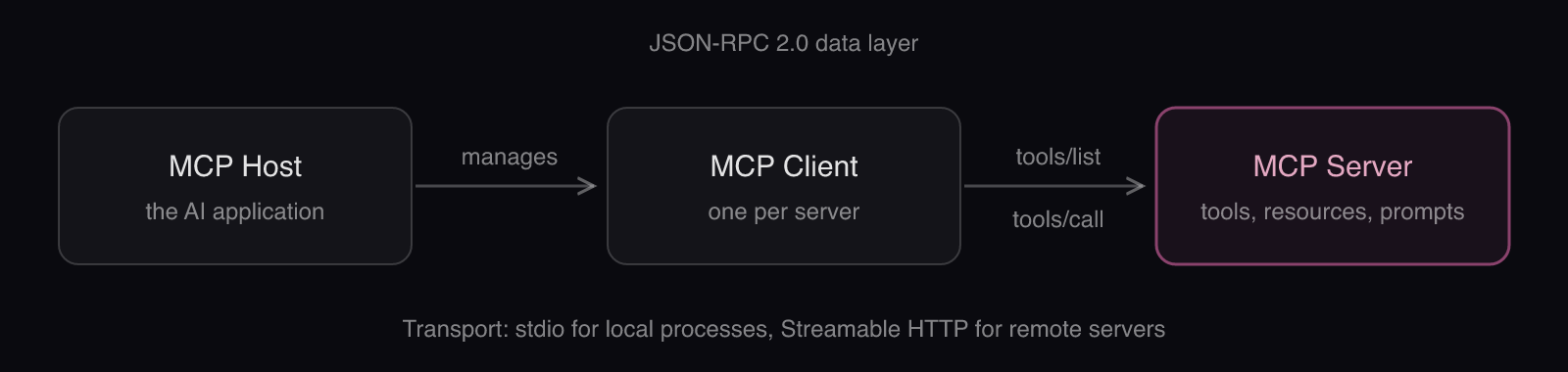
MCP follows a client-server architecture with three core participants:
MCP Host: The AI application that coordinates everything. This could be Claude Desktop, VS Code with Copilot, or a custom agent built on any framework. The host manages one or more MCP clients.
MCP Client: A component within the host that maintains a dedicated connection to a single MCP server. Each client handles the communication lifecycle with its corresponding server.
MCP Server: A program that exposes tools, resources, and prompts to MCP clients. Servers can run locally (using stdio transport) or remotely (using Streamable HTTP transport).
The protocol itself has two layers:
Data Layer: Built on JSON-RPC 2.0, this layer defines the message structure and semantics. It handles lifecycle management (connection initialization, capability negotiation, termination), and exposes three core primitives:
Tools: Executable functions that agents can invoke to perform actions, like querying a database, calling an API, or writing to a file system.
Resources: Data sources that provide contextual information, like file contents, database records, or API responses.
Prompts: Reusable templates that structure interactions with language models, such as system prompts or few-shot examples.
Transport Layer: Manages the actual communication channels. MCP supports two transport mechanisms:
Stdio Transport: Standard input/output streams for local process communication. Zero network overhead, ideal for tools running on the same machine.
Streamable HTTP Transport: HTTP POST for client-to-server messages with optional Server-Sent Events for streaming. This enables remote server communication and supports OAuth 2.1 for authentication.
The discovery flow is straightforward. A client connects to a server, negotiates capabilities during initialization, then calls tools/list to discover available tools. Each tool comes with a name, description, and JSON Schema defining its expected inputs. When the agent decides to use a tool, it sends a tools/call request with the appropriate arguments and receives a structured response.
MCP's Scalability Constraint
MCP works well for simple setups. One agent, a handful of MCP servers, each exposing a manageable number of tools. But there's a fundamental constraint that surfaces at scale.
Every tool connected to an MCP server sends its full description and schema to the LLM as part of the prompt context. Tool manifests, system instructions, conversation history and retrieved documents all compete for the same context window budget. As the number of tools grows, these descriptions can consume a significant portion of the available token space, even on models supporting 200K+ tokens.
The math gets unfavorable quickly. A single tool description with its JSON Schema might consume 200-500 tokens. Scale that to 100 tools and you're looking at 20,000 to 50,000 tokens consumed just by tool metadata, before any conversation, reasoning, or retrieved context enters the picture.
There have been improvements in reducing token consumption for MCP tool manifests. But even with optimization, the context window remains a hard ceiling. This isn't a bug in MCP. It's a consequence of how the protocol operates: at the tool level, with full schema visibility for the LLM. At a certain scale, that level of detail becomes the bottleneck.
This is precisely where A2A enters the picture.
What Is A2A (Agent-to-Agent Protocol)?
The A2A protocol, formally Agent2Agent, is an open standard that lets independent AI agents discover each other, delegate work, and exchange results across framework and vendor boundaries. Each agent publishes a JSON Agent Card describing what it can do and how to authenticate. Other agents read that card and send it stateful tasks. A2A reached version 1.0.0 and is governed by the Agentic AI Foundation.
That is the whole protocol in five sentences. The rest of this section is what each of those pieces actually looks like on the wire.
The Problem A2A Solves: Agent Discovery and Collaboration
MCP answers the question "how does an agent use a tool?" A2A answers a different question entirely: "how does an agent find and collaborate with another agent?"
As agentic systems grow beyond a single agent with a set of tools, teams inevitably need agents that can delegate work to other agents. A customer service agent needs to hand off billing questions to a billing specialist agent. A research agent needs to coordinate with a data retrieval agent and a summarization agent. A supervisory agent managing a complex workflow needs to discover which specialized agents are available and what each one can do.
Without a standard protocol for this, every agent-to-agent interaction becomes a custom integration. Teams end up building proprietary orchestration layers, tightly coupling agents to each other, and creating systems that are brittle and hard to extend. Cross-organization agent collaboration becomes nearly impossible.
A2A was designed to solve this. It provides an open, standardized protocol for agents to discover each other's capabilities, negotiate interactions, delegate tasks, and exchange results, regardless of what framework each agent was built with. An agent built on LangGraph can collaborate with an agent built on CrewAI or Semantic Kernel, as long as both speak A2A. If you are designing that topology from scratch, the trade-offs are covered in our guide to how multi-agent systems are built and secured.
Who Governs the A2A Protocol Now
This has changed twice, and most explainers are a version behind.
Google published A2A in April 2025 and donated it to the Linux Foundation later that year. In December 2025 the Linux Foundation formed the Agentic AI Foundation (AAIF), anchored by three contributed projects: Anthropic's Model Context Protocol, Block's goose, and OpenAI's AGENTS.md. A2A moved into AAIF on 17 August 2026, which put it under the same roof as MCP rather than in the Linux Foundation's wider portfolio.
Three things follow from that, and they matter more than the org chart:
Neither protocol is a single vendor's leverage anymore. AAIF's platinum membership includes Amazon Web Services, Anthropic, Block, Bloomberg, Cloudflare, Google, Microsoft and OpenAI. The foundation grew from fewer than 40 members at launch to more than 250.
The two specs are now maintained next to each other, which is why you should expect the integration story between them to get more explicit over time rather than less.
A2A is past the experimental stage. The specification is at version 1.0.0, with SDKs published for Python, Go, Java, JavaScript, .NET and Rust. Treating it as a research protocol is a year out of date.
How A2A Works: Architecture and Components
A2A defines a client agent and a remote agent. The client wants work done. The remote agent does it and owns the result. Everything between them is carried over ordinary web infrastructure.
Three transports. A2A does not invent a wire format. An implementation can expose JSON-RPC 2.0, gRPC, or HTTP+JSON/REST, and the Agent Card declares which ones it speaks. That choice is why an A2A agent drops into an existing service mesh or API gateway without special handling.
A small set of operations. The whole protocol surface is roughly eight calls:
SendMessageandSendStreamingMessage- hand work to a remote agent, optionally receiving incremental events as it runs.GetTask,ListTasks,CancelTask,SubscribeToTask- inspect, enumerate, stop, or re-attach to work already in flight.Push-notification config operations - register a webhook so a long-running task can call back instead of being polled.
GetExtendedAgentCard- fetch the fuller, authenticated version of an agent's card once you have credentials.
Messages, parts and artifacts. A Message carries a role, a messageId, a contextId that groups related work, optional referenceTaskIds, and an array of parts. A part is text, a file, or structured data, which is what lets two agents exchange a spreadsheet or an image without inventing an encoding. Output comes back as artifacts, each with its own artifactId, name, description and parts. Artifacts keep a stable name across revisions, so an agent refining a draft returns successive versions of the same artifact rather than a pile of unrelated blobs.
Streaming and callbacks. Streaming responses begin with the Task object, then emit status-update and artifact-update events, and close when the task reaches a terminal state. For work measured in minutes or hours, push notifications replace the stream entirely.
Agent Cards: How One Agent Discovers Another
The Agent Card is the piece of A2A that does the most work, and it is also the piece most often described with a stale URL.
An Agent Card is a JSON document published at the well-known path /.well-known/agent-card.json, following the RFC 8615 convention for well-known URIs. Older material (including earlier versions of this page) refers to /.well-known/agent.json. That is not the standard path.
The card declares:
name,description,urlandversion- who the agent is and where to reach it.skills- the capabilities it offers, described at a summary level rather than as tool schemas.capabilities- protocol features it supports, includingstreaming,pushNotificationsandextendedAgentCard.securitySchemesandsecurity- which credentials it accepts, expressed in the same shape the OpenAPI Specification uses.Default input and output modes - the media types it can accept and return.
There are three ways a client finds that card: fetching the well-known URI directly, querying a curated registry that indexes cards by skill or tag, or direct configuration where the card is supplied through config, environment, or a private API. Registries are the interesting case for enterprises, because a registry is the first natural place to decide which agents are allowed to be discoverable at all.
Two design choices are worth pausing on. First, the card is deliberately a summary. It does not enumerate the remote agent's tools, which is exactly why A2A avoids the context-window problem MCP runs into. Second, an agent can publish a limited public card and a richer authenticated extended card that only callers with valid credentials can retrieve. That is the protocol's answer to "I want to be discoverable without publishing my capability surface to the internet."
The A2A Task Lifecycle: Nine States, and Two That Pause
Once a client agent has a card, it sends work. A2A models that work as a Task: an object with an id, a contextId linking it to related work, a status carrying the current state, a message history, and the artifacts produced so far.
Tasks move through nine states, and the list is longer than most explainers admit:
submitted- the remote agent has accepted the task but has not started.working- the agent is executing.input-required- the agent has paused and needs something from the client before it can continue.auth-required- the agent has paused because it needs credentials it does not have.completed- finished, with artifacts returned.failed- the agent tried and could not finish.canceled- the client stopped it.rejected- the agent declined the task outright.unknown- state could not be determined.
completed, failed, canceled and rejected are terminal. input-required and auth-required are not failures at all. They are deliberate pauses that hand control back to the client, which is what makes an A2A task a negotiation rather than a single call.
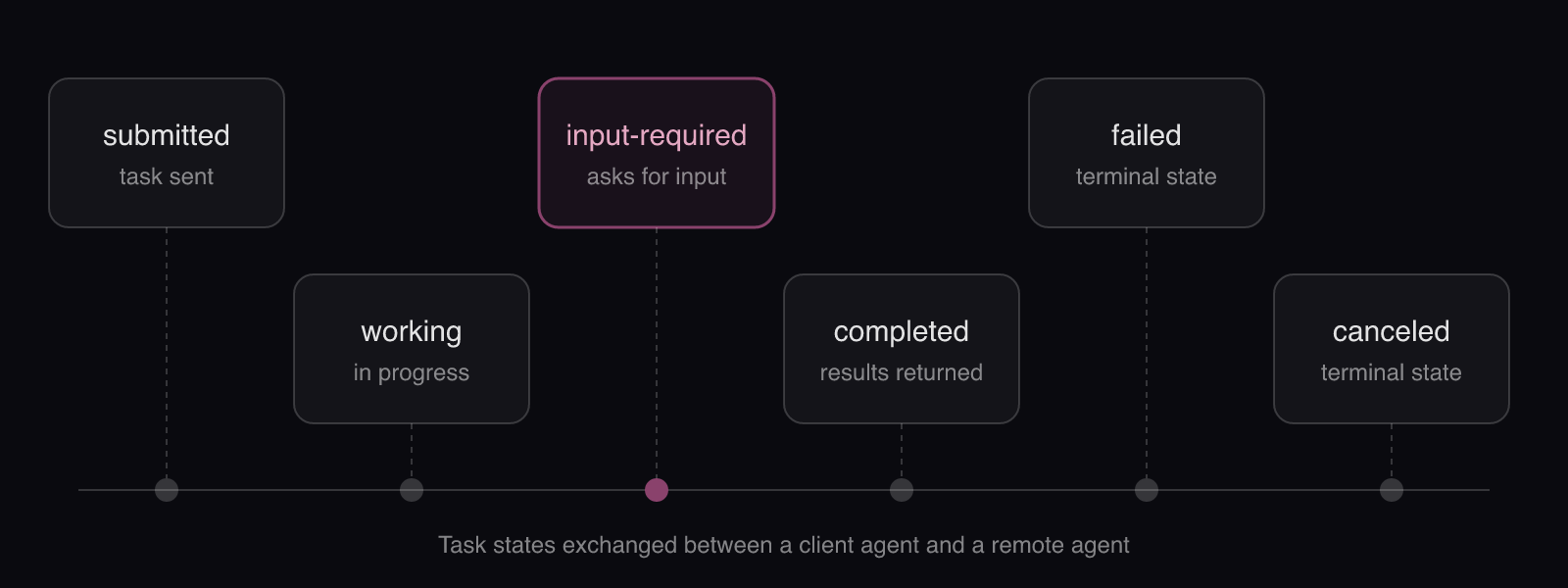
That auth-required state is the hinge between A2A and everything in the second half of this page. A task that stops and says "I need credentials I do not have" is the protocol admitting, in the open, that authorization is somebody else's job.
How A2A Handles Authentication
A2A deliberately defines no authentication scheme of its own. It reuses the web's, and the design is worth stating precisely because the consequences are easy to miss.
The remote agent declares what it accepts in the Agent Card's securitySchemes field, in the same shape the OpenAPI Specification uses. The available scheme types are an API key, HTTP authentication such as a bearer token, OAuth 2, OpenID Connect, and mutual TLS. The client obtains the actual credential out of band, through a process the protocol does not describe, then sends it in a standard HTTP header. The server must authenticate every incoming request. A missing or invalid credential returns 401 Unauthorized with a WWW-Authenticate header; a valid credential without sufficient permission returns 403 Forbidden.
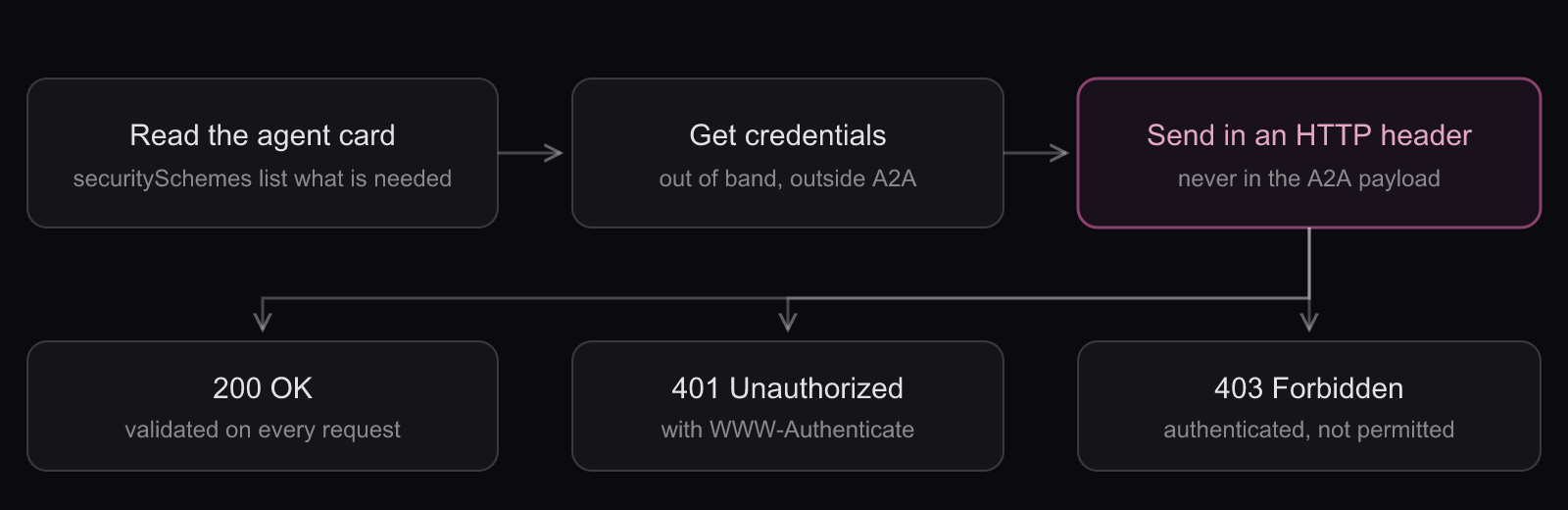
Now the consequence. The specification is explicit that A2A payloads do not carry user or client identity, and that identity is established at the transport layer instead. Read that twice if you are responsible for an audit trail. A remote agent receiving a task knows which client agent presented a credential. It does not, from the protocol alone, know which human that work was started for.
That is a reasonable specification decision and a serious architectural obligation. Everything about propagating a human's identity through a chain of agents has to be built on top, using standards that already exist:
OAuth 2.1 for the authorization-code flow with PKCE that gets the first credential into the chain.
OAuth token exchange (RFC 8693) to swap a user's token for a downstream token that records the delegation rather than impersonating the user silently.
Short-lived credentials so a token that leaks between agents expires in minutes rather than months.
Workload identity federation so the agent process itself proves what it is without a stored secret.
A2A gives you the pause (auth-required) and the vocabulary (securitySchemes). It does not give you the answer to "may this agent do this, for this person, right now." Its own guidance points the same way: grant access on a per-skill basis and hold to least privilege.
A2A's Design Philosophy
Several design principles distinguish A2A from MCP and shape how it fits into the broader agentic architecture:
Agent opacity: Agents interact without sharing internal memory, tools, or proprietary logic. A billing agent doesn't need to know what tools a customer service agent uses, and vice versa. This preserves intellectual property and security boundaries between agents, which is especially important for cross-organization collaboration.
Framework independence: A2A doesn't prescribe how agents are built internally. Any agent that can expose an Agent Card and handle A2A's task protocol can participate, regardless of the underlying framework, language, or LLM powering it.
Agent-level abstraction: A2A operates exclusively between agents. It doesn't interact directly with tools or end systems. When an agent receives a task via A2A, it uses its own internal mechanisms (which may include MCP) to fulfill that task. This separation of concerns keeps A2A focused on collaboration while leaving tool execution to protocols designed for it.
Cross-domain collaboration: A2A is designed for scenarios where agents from different organizations, different cloud environments, or different security domains need to work together. The protocol includes support for authentication, agent identity verification, and trust negotiation to make cross-boundary collaboration possible.
MCP vs. A2A: A Direct Comparison
Scope: Tool Access vs. Agent Collaboration
The most fundamental difference between MCP and A2A is what they connect.
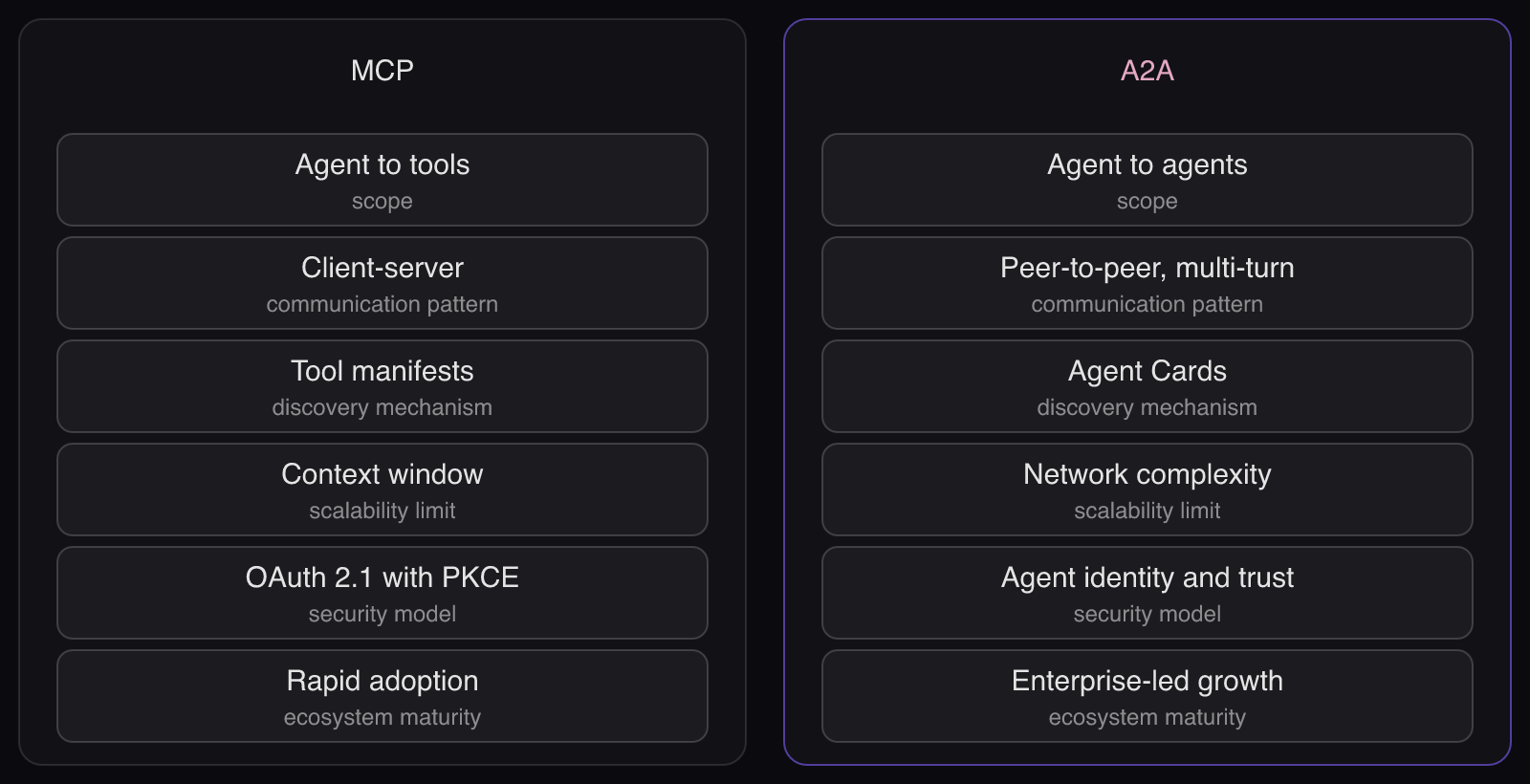
MCP connects agents to tools and resources. It operates at the primitive level, exposing individual functions, database queries, API calls, and file operations. When an agent needs to execute a specific action in the external world, MCP is the protocol that makes that happen.
A2A connects agents to other agents. It operates at a higher level of abstraction, facilitating collaboration between autonomous systems that each have their own reasoning, tools, and internal logic. When an agent needs to delegate a complex task to a specialist, A2A handles the discovery, negotiation, and communication.
Communication Pattern: Client-Server vs. Peer-to-Peer
MCP uses a strict client-server pattern. The MCP host (the AI application) creates clients that connect to servers. Communication flows in one direction: the client discovers and invokes tools exposed by the server. The server doesn't initiate requests to the client (though it can send notifications).
A2A supports more flexible communication patterns. While tasks flow from a client agent to a remote agent, the interaction can involve multi-turn exchanges where either party sends messages. The remote agent can request additional input, provide partial results, and negotiate the scope of the task. This is closer to a peer-to-peer conversation than a strict client-server invocation.
Discovery Mechanism: Tool Manifests vs. Agent Cards
MCP uses tool manifests for discovery. When a client connects to a server, it calls tools/list and receives the full schema for every available tool, including names, descriptions, and complete JSON Schema definitions for inputs and outputs. This gives the LLM detailed information about exactly what each tool can do and how to use it.
A2A uses Agent Cards for discovery. An Agent Card provides a high-level summary of an agent's capabilities without listing every internal tool or function. This is deliberately less detailed than an MCP tool manifest. The goal is to provide enough information for a supervisor agent to decide whether to route a task to a given agent, without consuming the context window budget that MCP's detailed schemas require.
Scalability Profile: Context Window vs. Network Complexity
MCP's scalability bottleneck is the LLM's context window. As tool count grows, tool schemas consume more tokens, leaving less room for conversation, reasoning, and retrieved context.
A2A's scalability challenges are network-level. As the number of collaborating agents grows, managing discovery, routing, authentication, and task coordination across many agents introduces complexity similar to managing a distributed system. But this complexity doesn't consume the LLM's context window, because Agent Cards are high-level summaries processed at the orchestration layer, not fed as detailed schemas into the model.
Security Model: OAuth 2.1 vs. Agent Identity Verification
MCP's security model centers on OAuth 2.1 with PKCE for authentication, dynamic client registration, and tool-level scoping. The specification recommends using bearer tokens and standard HTTP authentication methods for remote servers. Authorization is bound to the connection: a client authenticates to a server, and that session determines which tools it may call.
A2A takes the opposite approach and defines nothing. It declares required schemes in the Agent Card and delegates the rest to HTTP, which means an A2A deployment inherits whatever identity infrastructure it is placed in. Strong if that infrastructure is strong. Absent if it isn't. The practical difference is where the gap sits: MCP's gap is between servers (each one authenticates independently), while A2A's gap is between the transport layer and the payload, because the request carries no record of the person behind it.
Ecosystem Maturity: Rapid Adoption vs. Enterprise-Led Growth
MCP has seen explosive adoption since its November 2024 launch. Within the first month, the GitHub repository attracted tens of thousands of stars. Today, the ecosystem includes thousands of MCP servers covering everything from database connectors to cloud platform integrations. The rapid growth is driven by MCP's clear, immediate value proposition: connect your agent to your tools using one standard protocol.
A2A's adoption has followed a slower, more enterprise-driven trajectory. This isn't because A2A is less important. It's because the problems A2A solves (multi-agent orchestration, cross-organization collaboration) only surface at a level of architectural maturity that most teams haven't yet reached. The v1.0.0 release and the move into AAIF both point the same direction: the protocol is stable, and adoption is now an architecture question rather than a bet on whether the standard will survive.
MCP vs. A2A Comparison Table
Dimension | MCP | A2A |
|---|---|---|
Created by | Anthropic (Nov 2024) | Google (April 2025) |
Governed by | Agentic AI Foundation (Linux Foundation) | Agentic AI Foundation (joined Aug 2026) |
Spec status | Dated spec revisions | Version 1.0.0 |
Primary purpose | Tool discovery and invocation | Agent discovery and collaboration |
Communication model | Client to Server | Agent to Agent |
Discovery mechanism | Tool manifests / JSON Schemas | Agent Cards |
Discovery document |
|
|
Operates at | Tool level | Agent level |
Network analogy | Layer 2 (data link) | Layer 3 (network routing) |
Transport | Stdio, Streamable HTTP | JSON-RPC 2.0, gRPC, HTTP+JSON |
Auth model | OAuth 2.1, PKCE | Declared in the card, enforced over HTTP |
Identity in the payload | Bound to the authenticated connection | None, identity sits at the transport layer |
Core primitives | Tools, Resources, Prompts | Agent Cards, Tasks, Messages |
Scalability limit | Context window | Network complexity |
Interaction style | Stateless invocations | Stateful, multi-turn tasks |
Agent opacity | Agents see full tool schemas | Agents see capability summaries only |
Adoption curve | Rapid (thousands of servers) | Gradual, enterprise-led |
Best for | Single agent + multiple tools | Multi-agent orchestration |
Why "MCP vs. A2A" Is the Wrong Question
The Layer-2 / Layer-3 Mental Model
The most useful way to understand how MCP and A2A relate to each other comes from network engineering, an analogy explored by Cisco's Rob Barton.
In the early days of computer networking, networks were small and self-contained. A single Layer-2 domain (the data link layer) handled all communication. Devices could talk directly to each other within the local network. But as networks grew and needed to interconnect, Layer-2 alone could not scale. Routers and routing protocols (Layer-3, the network layer) were introduced to aggregate information at a higher level and route traffic between networks.
MCP is the Layer-2 of agentic AI. It provides detailed, direct access to tools within a defined scope. An agent connected via MCP can see every tool, understand every schema, and invoke any function. That level of detail is powerful within a bounded domain, but it doesn't scale indefinitely.
A2A is the Layer-3. It operates at a higher level of abstraction, using Agent Cards (analogous to routing tables) to describe capabilities in summarized terms. Instead of exposing every tool's schema, an Agent Card tells a supervisor agent: "I can handle billing inquiries" or "I specialize in RF analysis." The supervisor routes the task without needing to know the internal details.
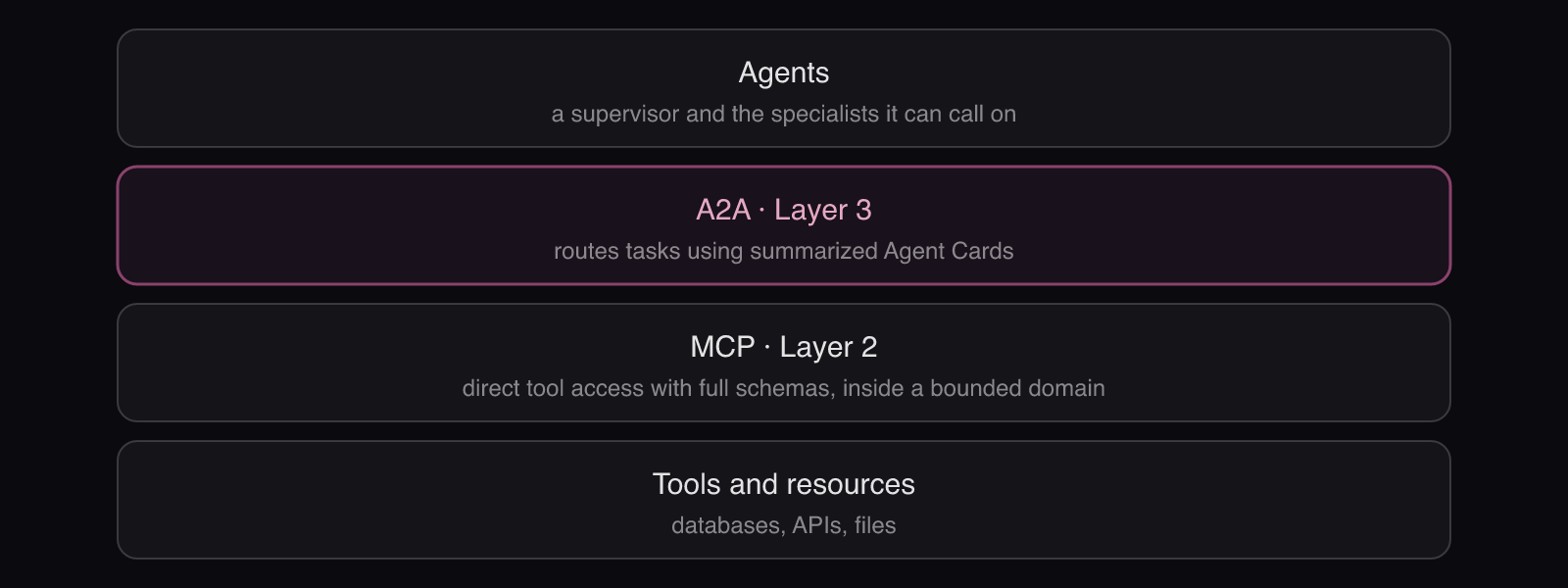
Just as modern networks require both Layer-2 and Layer-3 to function, production-grade agentic systems will require both MCP and A2A. The question isn't which protocol to use. It's how to architect the full stack.
The Real Architecture: MCP + A2A Working Together
In practice, here is how MCP and A2A combine in a multi-agent system:
A supervisor agent receives a complex request, such as "analyze our Q1 customer churn and recommend retention strategies."
The supervisor uses A2A to discover specialized agents via their Agent Cards. It finds a data analysis agent, a CRM query agent, and a strategy recommendation agent.
The supervisor delegates sub-tasks to each specialist via A2A's task protocol.
Each specialist agent uses MCP internally to connect to its specific tools. The data analysis agent invokes database queries. The CRM agent calls Salesforce APIs. The strategy agent pulls from internal knowledge bases.
Results flow back through A2A as each specialist completes its task, and the supervisor synthesizes the final output.
In this architecture, A2A handles the orchestration layer (which agent should do what), while MCP handles the execution layer (how each agent actually does its work). Neither protocol replaces the other. They operate at different levels of the stack and solve different problems. And when the execution layer involves secure access to MCP servers, that's where governance becomes critical.
When to Use MCP Alone vs. MCP + A2A
Not every system needs both protocols. Here's a practical decision framework:
MCP alone is sufficient when:
You have a single agent with a manageable set of tools (roughly under 30-50, depending on schema complexity)
All tools are within the same trust domain
There's no need for agent-to-agent delegation
The context window budget can accommodate all tool schemas plus conversation
MCP + A2A becomes necessary when:
You are building a multi-agent system where specialized agents handle different domains
The total tool count exceeds what a single agent's context window can handle
Agents need to be developed and deployed independently by different teams
Cross-organization agent collaboration is required
You need task delegation with multi-turn negotiation, not just tool invocation
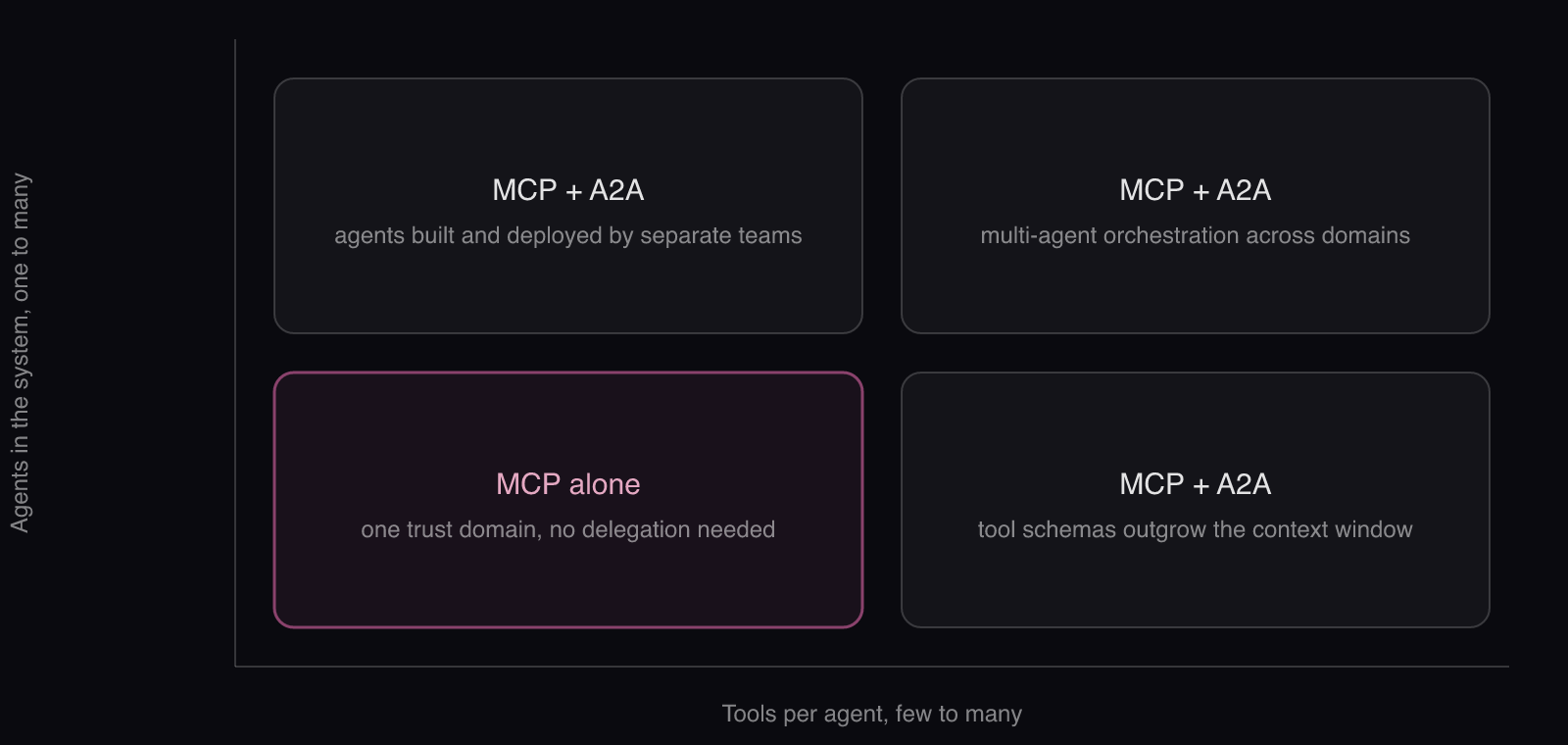
The transition point usually arrives when a team realizes their single-agent system is either hitting context window limits or becoming too complex for one agent to manage effectively. That's the signal to introduce A2A for agent-level orchestration while keeping MCP for tool-level execution.
The Missing Layer: Security and Governance Across Both Protocols
Authentication and Authorization in MCP
MCP's security model is built around OAuth 2.1 with PKCE (Proof Key for Code Exchange). Remote MCP servers authenticate clients using bearer tokens, and the specification supports dynamic client registration so new clients can onboard without pre-configuration.
At the tool level, MCP supports scoping, meaning an authenticated client can be restricted to a subset of available tools based on their permissions. The protocol also includes consent mechanisms where the host application can prompt the user before executing sensitive tool calls.
However, MCP's authorization model is primarily connection-level. A client authenticates to a server, and that authentication governs what tools are accessible. There's no built-in mechanism for enforcing per-user, per-tenant, or per-agent policies that span multiple MCP servers. If an agent connects to five different MCP servers, each server handles its own authentication independently. Closing that gap is the subject of how identity works across MCP servers, and it is one of the first problems enterprises hit when they scale an agent deployment.
Identity and Trust in A2A
A2A's position is easier to state and harder to live with: the protocol verifies that a caller presented an acceptable credential, and stops there.
An Agent Card advertises which schemes it accepts, a client acquires a credential out of band, and the remote agent validates that credential on every request. What the protocol does not do is carry the originating user's identity in the message. The specification says so plainly: identity is established at the transport layer, not in the A2A payload. A remote agent knows a client agent authenticated. It does not know, from A2A alone, on whose behalf.
In a single hop that is manageable, because the calling service usually still holds the user's session. Across two or three hops it stops being manageable. A supervisor agent authenticates to a specialist, the specialist authenticates to another specialist, and by the third hop the only thing travelling is a service credential. Every question an auditor actually asks (which person triggered this, were they entitled to the result, who approved the sensitive step) has to be answered by infrastructure the protocol does not define.
Building that infrastructure means deciding four things, none of which A2A decides for you:
What the agent may do at all. Capability boundaries are policy, not protocol, which is the subject of agent authorization.
How delegation is recorded. OAuth token exchange (RFC 8693) produces a downstream token that states it was issued on a user's behalf, instead of quietly reusing the user's own token.
What happens at a sensitive boundary. A task that crosses into higher-risk territory should trigger step-up authentication rather than proceeding on a credential minted an hour ago.
When a human must decide. The
auth-requiredstate is a natural hook for human in the loop approval, because the protocol has already agreed to stop and wait.
None of this is a criticism of A2A. A protocol that tried to define enterprise authorization would be ignored. But the honest reading is that A2A hands you a clean pause and a clean vocabulary, and leaves accountability as an explicit design task.
The Combined Security Challenge Nobody Is Solving
Here's the problem that every article about MCP vs. A2A skips over: what happens when you deploy both protocols together?
In a combined MCP + A2A architecture, the security surface includes:
Agent-to-agent trust (A2A): Which agents are allowed to discover and communicate with which other agents?
Tool-level access control (MCP): Which tools is a given agent allowed to invoke, and under what conditions?
Full chain auditability: When a user requests something, and a supervisor agent delegates to a specialist agent, which then invokes a tool via MCP, can you trace the entire chain? User to agent to agent to tool?
Policy consistency: Are the access control rules governing A2A routing consistent with the authorization rules governing MCP tool access? Or can an agent bypass tool-level restrictions by routing through a different agent?
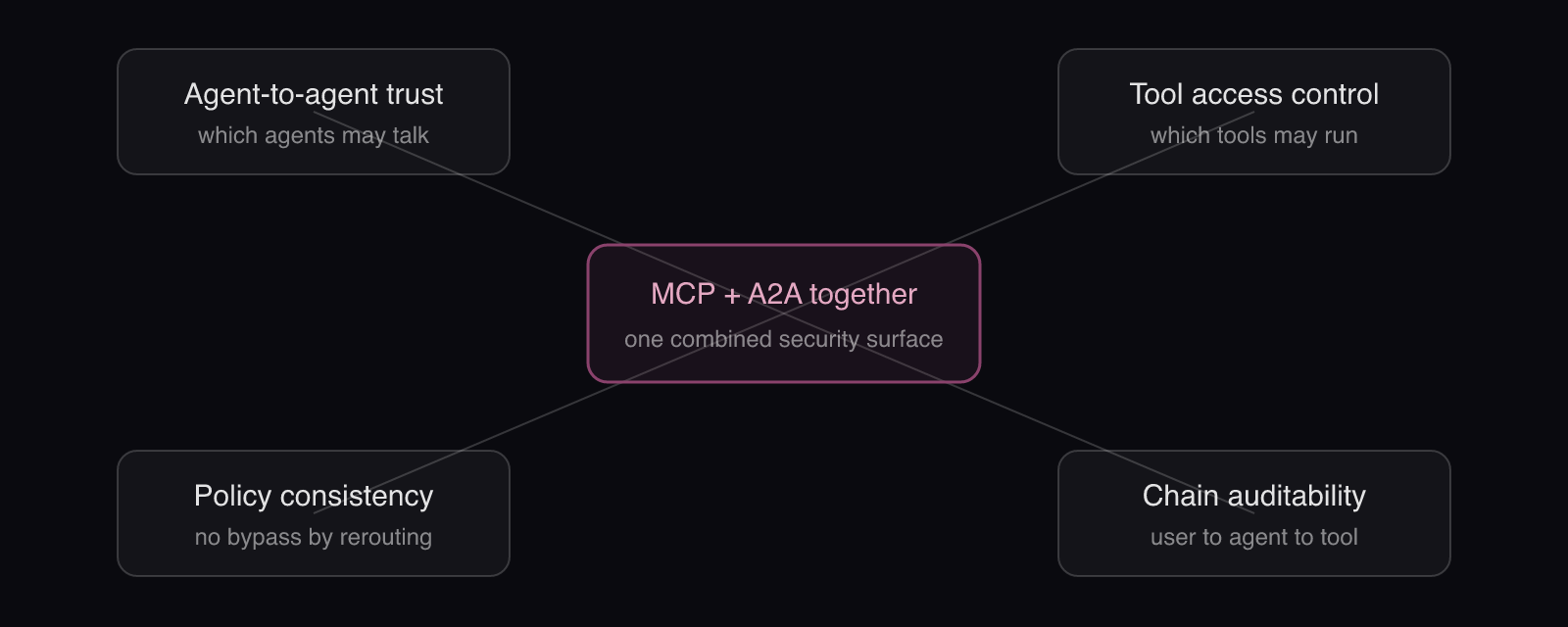
These aren't theoretical concerns. In any enterprise deployment where multiple agents collaborate across multiple tool servers, the governance gap between protocols becomes a real attack surface. An ungoverned agent that can discover other agents via A2A and invoke any tool via MCP has effectively unlimited access to your systems.
The protocols themselves don't solve this. MCP specifies how to authenticate to a single server. A2A specifies how to verify that a caller presented a credential. Neither specifies an accountability layer that enforces one policy, and produces one audit trail, across both.
Enterprise Architecture Patterns for MCP + A2A
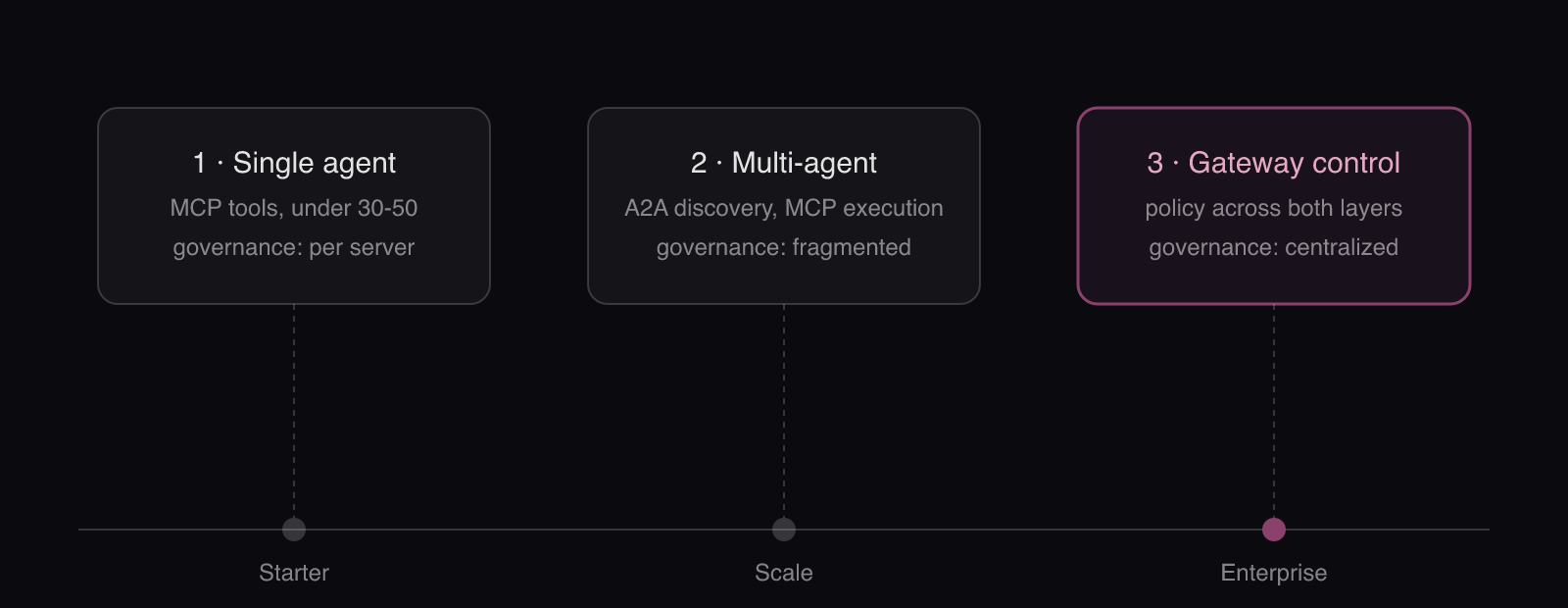
Pattern 1: Single Agent with MCP Tools (Starter)
The simplest architecture. One supervisory agent connected directly to a set of MCP servers. The agent discovers tools, reasons about which ones to use, and invokes them directly.
Works well for: Prototypes, internal tools with limited scope, use cases with fewer than 30-50 tools.
Breaks down when: Tool count exceeds the context window budget, or the agent needs to coordinate with other specialized agents.
Governance: Straightforward. The agent authenticates to each MCP server, and tool-level permissions are managed per-server.
Pattern 2: Multi-Agent with A2A Discovery + MCP Execution (Scale)
A supervisor agent uses A2A to discover and delegate to specialized agents. Each specialist has its own set of MCP tool connections. The supervisor does not need to know what tools each specialist uses. It only sees Agent Cards describing high-level capabilities.
Works well for: Production systems with domain-specific agents (finance, HR, engineering), teams that need to develop and deploy agents independently.
Breaks down when: There is no centralized control over which agents can communicate with each other, which tools each agent can access, or what data flows between them.
Governance: Fragmented. Each specialist agent manages its own MCP connections. The supervisor trusts that each specialist will respect access boundaries, but there's no centralized enforcement.
Pattern 3: Governed Multi-Agent with Gateway Control (Enterprise)
The full enterprise architecture. A gateway layer sits between agents and tools, enforcing policies across both the A2A and MCP layers. The gateway controls:
Which agents can discover and communicate with which other agents (A2A governance)
Which tools each agent can invoke, and under what conditions (MCP governance)
Identity propagation: ensuring the original user's permissions flow through the entire agent chain
Audit logging: capturing the full trace from user request to agent delegation to tool invocation
Data governance: controlling what data can flow between agents and what needs to be masked or redacted
Works well for: Enterprises deploying multi-agent systems at scale, regulated industries, any organization where ungoverned agent sprawl is a risk.
This is the only pattern that provides true visibility and control across both protocol layers. And it is the pattern that the current MCP vs. A2A conversation almost entirely ignores.
How Agen Governs the Full MCP + A2A Stack
This is where the architectural discussion becomes practical.
Agen (by Frontegg) is built to be the accountability layer for agentic systems. It sits between humans, AI agents, and the applications they access, enforcing identity, permissions, and governance before any action occurs.
In the context of MCP + A2A architectures, Agen provides:
Unified identity for users and agents: One identity model that covers both human users and the agents acting on their behalf. When an agent invokes a tool via MCP or delegates to another agent via A2A, the system knows who initiated the action and whose permissions apply. Tying an agent's identity to the person it acts for is what makes the rest of the chain auditable.
Tool-level access control (MCP governance): Agen's enterprise-grade MCP gateway provides fine-grained authorization over which tools each agent can access. This isn't just authentication to the MCP server. It's policy-based control over individual tool invocations, scoped by user, tenant, role, and context.
Agent-level routing governance (A2A governance): Agen controls which agents can discover and collaborate with which other agents. This prevents ungoverned agent sprawl where any agent can delegate to any other agent without oversight.
Full audit trail across both protocols: Every action, from the initial user request through agent-to-agent delegation to the final tool invocation, is logged and traceable. The chain is never broken. You can always answer the question: who did what, through which agent, using which tool, and on whose behalf.
Data governance and guardrails: Agen enforces data masking, redaction policies, and guardrails on agent actions. Data that flows between agents or gets exposed through tool responses is governed by policies defined once and applied everywhere.
Deployment flexibility: Agen deploys as a managed cloud service, within a customer's VPC, on-premises, or even on-device with a lightweight runtime. The governance layer lives where the data lives. For SaaS companies exposing their products to AI agents, Agen for SaaS provides the same governance for external agent traffic. For internal agent deployments, Agen for Work gives security teams visibility and control over employee-driven agent activity.
For teams building multi-agent systems that combine MCP and A2A, this is the layer the protocols leave empty. MCP and A2A define how agents talk to tools and to each other. Agen governs who is allowed to talk to whom, what they're allowed to do, and what data they're allowed to see.
An A2A and MCP Rollout Checklist
Everything above is architecture. This is the part you can work through on a Monday, in the order the decisions actually arrive.
Inventory the agents before the protocols. List every agent already running, who owns it, and what it can reach today. Protocol choices made over an unknown inventory just formalize the sprawl.
Decide what is discoverable. An Agent Card at
/.well-known/agent-card.jsonis a public statement of capability. Decide per agent whether it is published openly, published to an internal registry, or configured privately.Split the public card from the extended card. Publish the minimum that lets a legitimate caller decide to engage, and keep the detailed skill list behind
GetExtendedAgentCard.Pick one credential story and write it down. Choose the
securitySchemesyour agents will accept, standardize on OAuth 2.1 where you can, and stop the per-team improvisation early.Make credentials short-lived. Agent credentials leak through logs, prompts and traces. Short-lived credentials turn that from a breach into an inconvenience.
Give the agent process its own identity. Workload identity federation lets a running agent prove what it is without a stored secret, which is the difference between an identity and a password in an environment variable.
Carry the human through the chain. Use OAuth token exchange at every delegation so the downstream token records who the work is for, rather than losing the person at the first hop.
Write the authorization rules once, at the boundary. Per-skill and per-tool decisions belong in one place. Scattering them across each agent's own code is how the same action ends up permitted through one route and denied through another. Start from agent authorization.
Define the stop conditions. Name the actions that require step-up authentication or a human in the loop, and wire them to the
auth-requiredandinput-requiredstates instead of inventing a side channel.Log the chain, not the hops. A record that says "agent B called tool X" is not an audit trail. The trail has to join the person, the delegating agent, the executing agent, the tool and the data, or you cannot answer the only question that matters after an incident.
Teams that do the first three and skip the rest ship faster and spend the following quarter reconstructing who did what.
The Future of MCP and A2A
Protocol Convergence or Continued Specialization?
There's ongoing discussion about whether MCP and A2A will converge into a single protocol or continue as separate, specialized standards. The 2026 evidence points clearly toward continued specialization under shared governance.
Both protocols now sit inside the Agentic AI Foundation, so the neutral-home question is settled. What is not settled, and will not be, is scope. MCP is optimized for tool-level precision. A2A is optimized for agent-level collaboration. Merging them would compromise the strengths of each, and the shared foundation removes the main reason two competing standards usually collapse into one.
What's more likely is tighter integration at the specification level, with clearer guidance on how MCP servers can be exposed as A2A-compatible resources and how A2A Agent Cards can reference MCP tool capabilities. The A2A documentation already describes how A2A servers can expose skills as MCP-compatible resources for simpler, stateless interactions.
The Role of Gateways in Multi-Protocol Agent Systems
As both protocols mature, the gateway layer will become the critical architectural component. Just as API gateways became essential when organizations moved from monolithic APIs to microservice architectures, agent gateways will become essential when organizations move from single-agent prototypes to multi-agent production systems.
The gateway is where policy enforcement, identity propagation, rate limiting, audit logging, and data governance converge. It's the point of control in an otherwise decentralized system. Teams that deploy MCP + A2A without a governance gateway will face the same sprawl, visibility gaps, and security risks that teams faced when deploying microservices without API management.
From "Both Are Needed" to "Both Must Be Governed"
The current consensus in the market is that MCP and A2A are complementary. That consensus is correct but incomplete.
Saying both are needed is the starting point. The next step is recognizing that both must be governed. Complementary and ungoverned is a liability, not an architecture. The protocols define the communication standards. Governance defines who's allowed to communicate, what they're allowed to do, and who's accountable when something goes wrong.
The teams that recognize this early, that treat governance as an architectural layer rather than an afterthought, are the ones that will scale their agentic systems into durable, production-grade deployments.
Frequently Asked Questions
What is the A2A protocol?
The A2A protocol (Agent2Agent) is an open standard that lets independent AI agents discover each other, delegate tasks, and exchange results across different frameworks and vendors. Each agent publishes a JSON Agent Card describing its skills and authentication requirements. The specification is at version 1.0.0 and is governed by the Agentic AI Foundation at the Linux Foundation.
What is the difference between MCP and A2A?
MCP (Model Context Protocol) standardizes how AI agents connect to and invoke external tools, APIs, and data sources. A2A (Agent-to-Agent Protocol) standardizes how AI agents discover and collaborate with each other. MCP operates at the tool level (agent-to-tool). A2A operates at the agent level (agent-to-agent). They solve different problems at different layers of the agentic stack.
How do agents authenticate in A2A?
A2A defines no authentication scheme of its own. A remote agent declares accepted schemes (API key, HTTP bearer, OAuth 2, OpenID Connect or mutual TLS) in its Agent Card, the client obtains the credential out of band, and it travels in a standard HTTP header. Failures return 401 with WWW-Authenticate, or 403. Identity lives at the transport layer, never in the payload.
Is MCP better than A2A?
Neither protocol is universally better. They serve different purposes, and comparing them head-to-head misses the point. MCP is the right choice for connecting an agent to tools and resources. A2A is the right choice for enabling multi-agent orchestration and cross-domain collaboration. Most production systems will use both, with MCP handling tool execution and A2A handling agent coordination.
Can MCP and A2A be used together?
Yes, and this is the recommended approach for any system that involves multiple agents. A supervisor agent uses A2A to discover and delegate tasks to specialized agents. Each specialist agent uses MCP internally to invoke the specific tools it needs. A2A provides scalable agent-level routing. MCP provides precise tool-level execution.
Who created MCP and A2A?
MCP was created by Anthropic and released in November 2024. A2A was created by Google and released in April 2025. Both are now hosted projects of the Agentic AI Foundation at the Linux Foundation: MCP as a founding contribution in December 2025, A2A on joining in August 2026.
What is an Agent Card in A2A?
An Agent Card is a structured metadata document that describes an agent's capabilities at a high level. It is published at /.well-known/agent-card.json and includes the agent's name, description, skills, supported interaction modes, security schemes, and endpoint URL. Agent Cards let other agents discover what an agent can do without exposing its internal tools. An authenticated extended card can carry more detail for callers who present valid credentials.
Does MCP replace APIs?
MCP doesn't replace APIs. It provides a standard layer on top of APIs that makes them accessible to AI agents. MCP servers wrap existing APIs, databases, and services in a protocol that agents can discover, understand, and invoke using natural language. The underlying APIs still exist and function normally. MCP simply provides a consistent interface for AI agents to interact with them.
What are the security risks of using MCP and A2A together?
The primary risk is the governance gap between the two protocols. MCP handles authentication at the individual server level. A2A validates that a caller presented a credential, and carries no user identity in the payload. Without one accountability layer spanning both, an agent could bypass tool-level restrictions by routing through another agent, or reach data that should be out of scope by exploiting the gap between agent-level and tool-level permissions.
How do you govern AI agents using both MCP and A2A?
Governance requires a layer that sits between agents and the tools and agents they interact with. It enforces identity-aware access control across both protocols, maintains a full audit trail from user request through agent delegation to tool invocation, applies data governance policies (masking, redaction, guardrails) consistently, and provides observability into the entire agent chain. Agen is purpose-built for this, providing unified governance across both MCP tool access and A2A agent collaboration.