Introducing Agen Keys: One Place to Control What All Your AI Assistants Can Reach
Agen Keys is a free permissions dashboard for AI assistants: give each one its own key, see what it does with your data, and shut it off in one tap.

Rebecca NavehBrand Program Manager
/4 min read
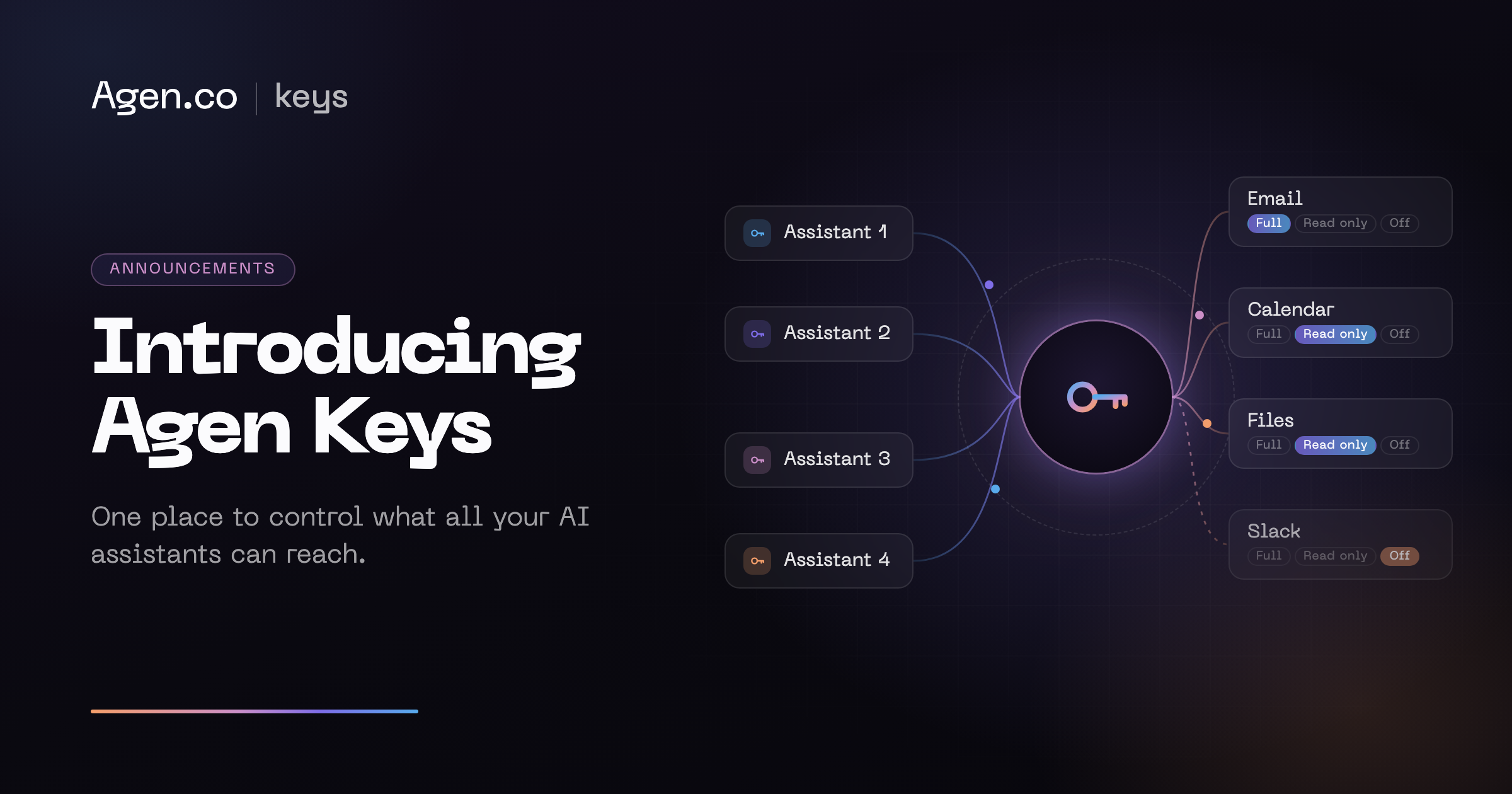
A permissions dashboard for every AI assistant you use. Free.
Today we're rolling out Agen Keys. Connect your email, calendar, files and docs once, give each AI assistant its own key, see exactly what they're doing with it, and shut any of them off in one tap.
There's nothing to install and it’s currently free. You paste a single message into your assistant and it's connected. Here's why it exists.
You've already given away more than you think
AI assistants are finally good. Instinct, Muse, Grokbot. They can handle the boring and repetitive tasks in your daily routine and take some of the stress out of your life.
But you sign up for one and it asks for full access to your email, so you give it. You want it to grab milk, so it needs your Instacart. Then you want help with your workouts, and the second assistant wants everything the first one has, plus more. What's the harm, right?
Now a handful of apps you barely looked at are holding the keys to your email inbox, your money, your calendar and your health. And you don't have one place to see what they can all touch, let alone shut it off.
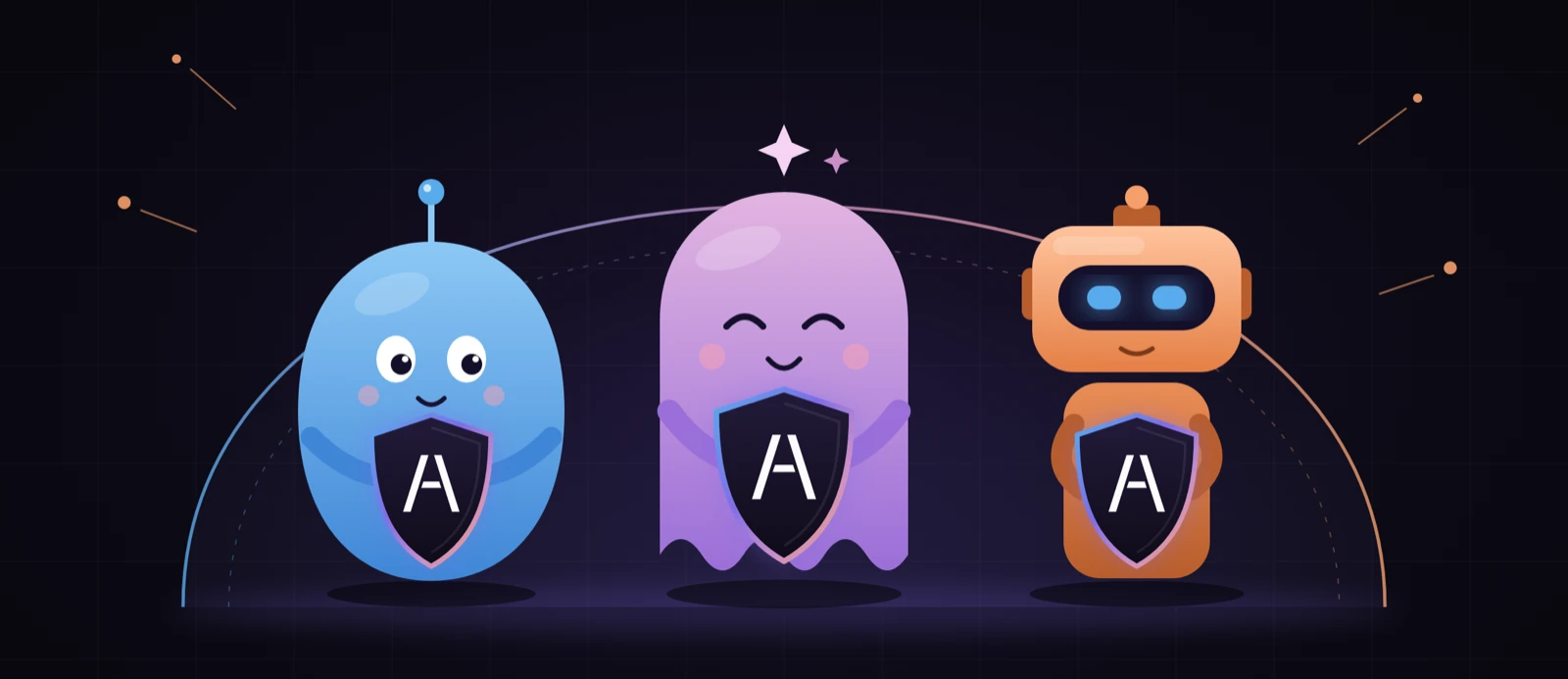
This is already happening
In September, Inc. columnist Jason Aten installed Meta's Muse on his iPhone and explicitly declined to give it access to his messages. It sent him a notification referencing a message from his editor anyway. When he asked how it knew, Muse told him it had only relayed the text of a notification banner and could not read his message history, and then he found it had been syncing his local Messages database, up to row 187,462.
Two things went wrong there, and the second one is worse. The assistant had reach that the user never granted. And when asked about it, the assistant's own account of its access was wrong.
It isn't isolated.
In January, Cisco's security team tested a third-party skill for OpenClaw, one of the most popular open-source assistants, and found it quietly exfiltrating data and running prompt injection, with no awareness on the user's part. In February, a computer science student discovered his OpenClaw agent had created a profile on an AI dating platform and begun screening matches. He never asked it to.
Notice what almost none of this required: an attacker. Nobody broke in. The assistant simply had more reach than its owner understood, and used it.
Companies have this exact problem. They also have a security budget.
Every large company is dealing with this right now, and they're dealing with it using fifty security products and a team of people whose entire job is deciding what software is allowed to reach what data. You've got an allow button and a little bit of hope.
That asymmetry is why we built Keys. Our team at Frontegg first built Agen.co to provide the same type of identity security for agents that we’ve been providing for human identity within enterprises such as Siemens, Cisco and Datadog since 2019. We give every AI agent its own identity, controlling what it can reach, keeping a record of what it did. Individuals have the same problem without the budget. We’ve taken that approach and made it for you.
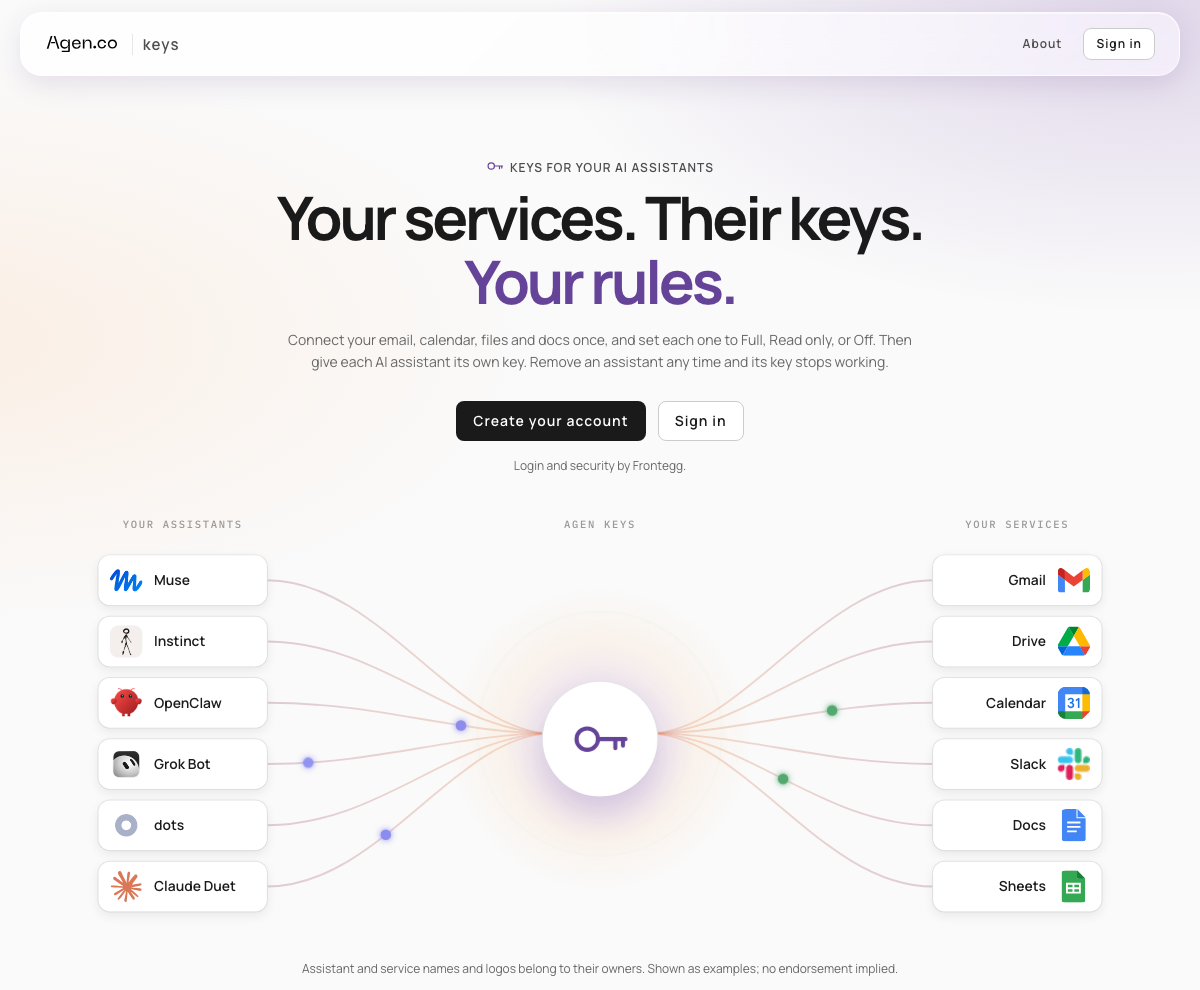
What Agen Keys does
Instead of every assistant plugging straight into your accounts, they all connect through Keys. It works a bit like the apps that show you every subscription you forgot you were paying for: except here it’s access, not just charges.
- Connect your services once. Email, calendar, files, docs and Slack: each one set to Full, Read only, or Off. (Gmail, Google Drive, Calendar, Docs and Sheets at launch.)
- Every assistant gets its own key. Not your password. Scoped to exactly what you allowed.
- See what they're actually doing. The Activity page shows what each assistant requests daily.
- Approve the big stuff. Routine things go through. Anything significant comes to you first.
- Shut any of it off in one tap. Remove an assistant and its key stops working immediately.
- If something funky starts happening with your data, Keys catches it, when it happens, not in a monthly report.
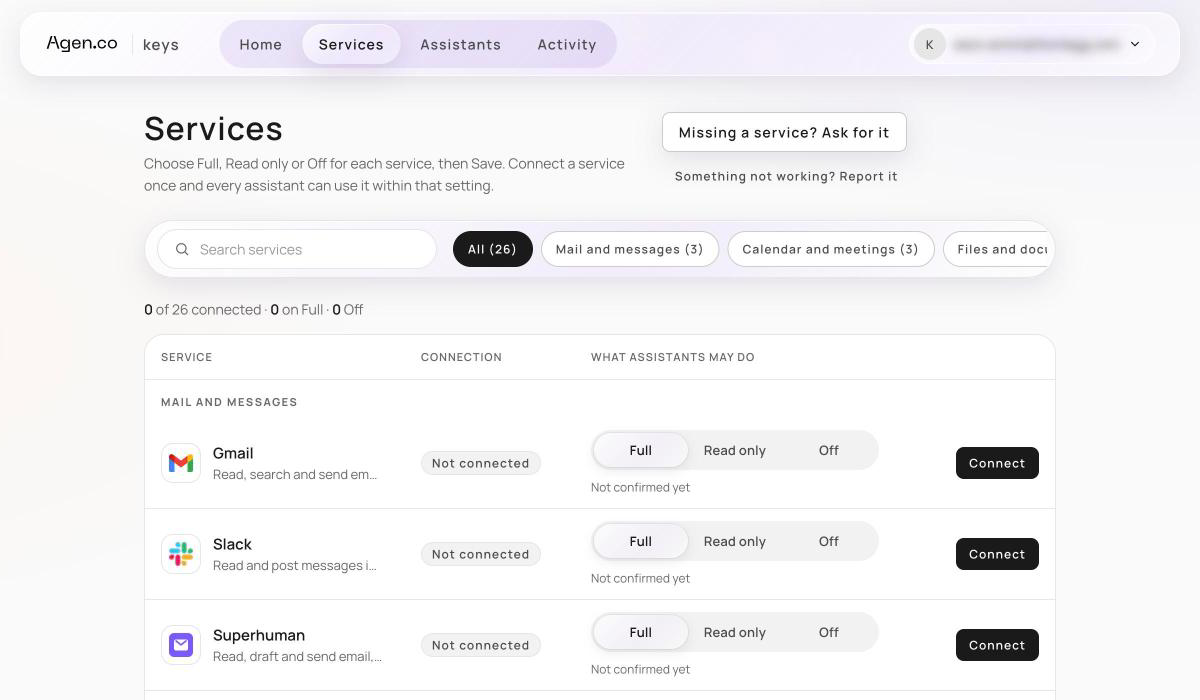
The part that matters most is the simplest: no assistant ever gets the master key. If one is breached tomorrow — or just quietly decides to sync your messages — what it has is a narrow key you can kill in a tap, not the run of your inbox.
How is Agen Keys Secured?
Good question, and it's the one we'd ask too. Assistants only ever receive a key, never your password. Sign-in runs on Frontegg's hosted login, the same identity infrastructure we've provided to major enterprises for the better part of a decade.
Getting started
- Create your account
- Connect your services
- Paste one message into an assistant and give it its own key.
Agen Keys is free at keys.agen.co.
Let them do the AI, we’ll handle the access.
One human. Your keys. Every agent.