New researchThe State of Autonomous Agent Governance: what 300 CISOs and CSOs told us300 CISOs on agent governanceGet the report →
Agen.co
  • Platform
  • Solutions
  • Resources
  • Customers
  • Pricing
  • AI-Native Guide
LoginBook a demo
Platform
Platform overviewOne platform between every agent and everything it touchesArchitectureOne gateway between workforce and systemsWatch it liveThe portal governing, in real time
Capabilities
DiscoverEvery agent found, every agent ownedGovernPer-action verdicts in under 30msShieldAgenShield on the device, BrowserShield in the browser · EA
Foundation
Identity foundationAnchored to the IdP you already runExternal MCPCustomer and partner agents on the same policy plane
Watch the 2-minute platform tour →
By outcome
Confident AI adoptionSay yes to AI, without losing controlAccountability & auditA human answers for every agentAutonomous operationsGovernance that runs itselfRisk preventionStop the breach before the first action lands
By role
The CISOThe security teamIT & platformDevelopers
By industry
Financial servicesSoftware & technologyHealthcareConsumer & digital media
Use cases
Secure enterprise copilotsCopilot, Cursor, Claude Code, governed per actionGovern autonomous agentsAutonomy on the work, humans on the triggerStop AI data leaksBrowserShield stops the paste, early accessApprove agents in hoursOnboarding as a policy decisionMCP governanceInternal and external, one planeContinuous audit evidenceThe binder writes itself
The AI-Native Guide 2026: what an AI-native company actually runs →
Featured
State of Agent GovernanceNew research: 300 CISOs on the agents insideAI-Native Guide 2026Five stages, eight departments, one checklistPlatform comparisonsScored against vendor docs, every source publishedCustomer storiesProof from the field
Learn
All resourcesBlog & resource center ↗Learning CenterUse casesIndustriesWho it serves
Company
AboutTrust & securityPricingContact
Agen.cobyFrontegg
Identity-native agentic governance.
Scale AI agents. Keep a human accountable for every one.
SOC 2ISO 27001GDPRHIPAA
Platform
OverviewDiscoverGovernPolicy engineShieldIdentity foundation
Solutions
Confident AI adoptionAccountability & auditAutonomous operationsRisk prevention
Learn
AI-Native Guide 2026Use casesAgen for WorkAgen for SaaSIndustriesWho it serves
Company
AboutCustomersTrust & securityPricingBook a demo
Resources
Blog & resource centerLearning CenterPlatform comparisonsMCP GatewayAgent governance researchLive sessionsDocs
© 2026 Agen.co by Frontegg
Privacy PolicyTerms of Service
  1. Blog
  2. /
  3. Product
  4. /
  5. Should this AI agent take this action right now?
ProductAI GovernanceAgent PermissionsFeaturesMCP

Should this AI agent take this action right now?

See how Agen.co’s policy engine returns a verdict on every tool call through the MCP gateway in under 30ms, based on who’s asking, what they’re doing, and when.

Keon Armin
Keon ArminDigital Marketing Manager
November 2, 2026/4 min read
Should this AI agent take this action right now?

In this article

  1. What does “give it access to Gmail” actually mean?
  2. What if the exact same call happens at 2 a.m.?
  3. When a call gets blocked, can you see why?
  4. How do you go from “we should block that” to a rule?
  5. What if nobody wrote a rule for that tool?
  6. What can the policy engine do with a call?
  7. Where this fits in Agen.co

In this article

  1. What does “give it access to Gmail” actually mean?
  2. What if the exact same call happens at 2 a.m.?
  3. When a call gets blocked, can you see why?
  4. How do you go from “we should block that” to a rule?
  5. What if nobody wrote a rule for that tool?
  6. What can the policy engine do with a call?
  7. Where this fits in Agen.co

Say you give your support agent access to Gmail because you want it to read incoming messages.

Can it send a reply? Can it permanently delete a thread your legal team needs next week?

Those are three very different decisions. They all go through the same Gmail connection. And once an agent has access, it can make the call without a person sitting there to click the button.

So when the agent asks Gmail to do something, what should happen?

Agen.co’s policy engine answers that question on every tool call through our MCP gateway. We put together five walkthroughs in our demo tenant so you can see what happens when you change the action, the timing, or who’s asking.

What does “give it access to Gmail” actually mean?

In the first walkthrough, we give the support agent an exception for Gmail’s read tools. Delete stays under the baseline policy.

Then we test three calls. Listing messages goes through. Sending asks the user to confirm. Deleting gets blocked.
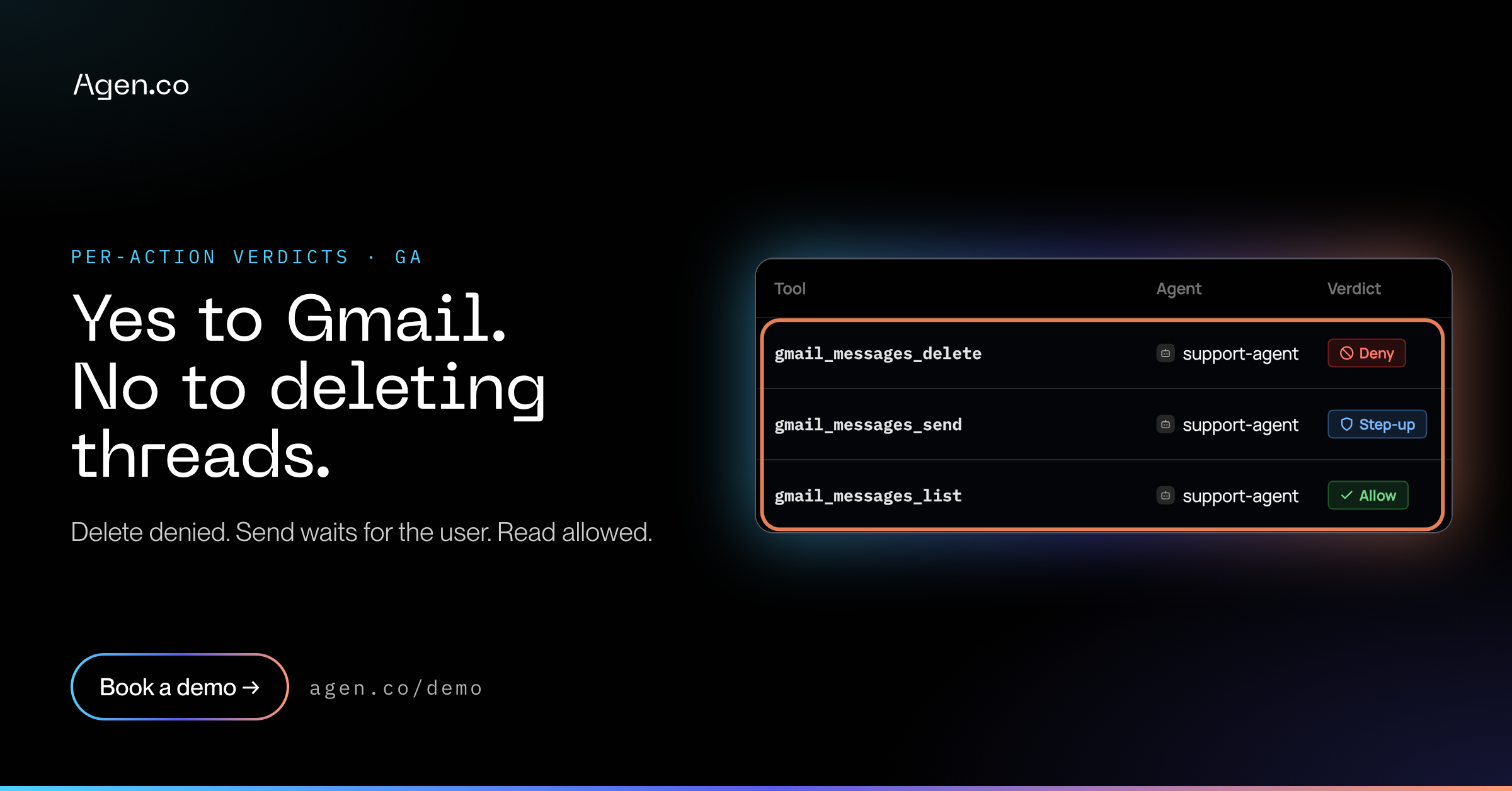
One Gmail connection, three Agen.co policy verdicts: list messages allowed, send held for step-up, delete denied
One connector, three verdicts.

When the agent makes those calls for real, you can see all three decisions in the live log. That’s the setup we’d want for a support agent. It can read what it needs to do its job, and we can decide separately what happens when it tries to send or delete something.

Watch “One connector, three verdicts” on the policy engine page →

What if the exact same call happens at 2 a.m.?

At 2:14 p.m., an agent exports a Salesforce report for a user. The export goes through.

At 2:14 a.m., it happens again. Same agent, same tool, same user. This time the call lands outside work hours.
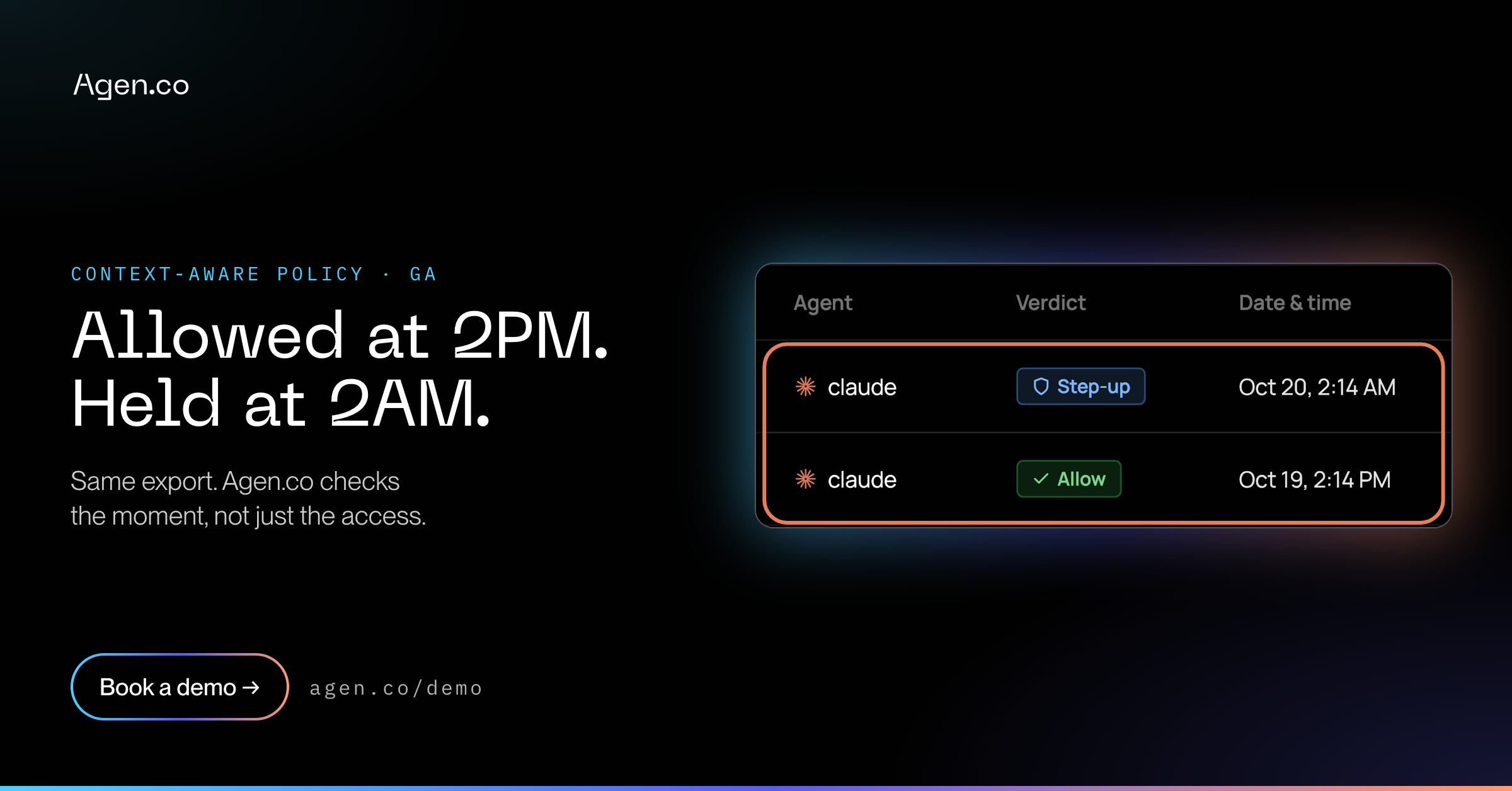
The same Salesforce export is allowed at 2 PM and held for user confirmation at 2 AM by the Agen.co policy engine
Same agent, same user, same export. This time, outside work hours.

The request falls outside work hours, so the policy engine asks the user to confirm on their phone. They see an export they didn’t start and deny it. The log records the verdict, the policy that triggered it, the IP address, and who was acting. You can also use geo-fencing to set rules based on where a request comes from.

The next time that export runs, the engine evaluates it again with whatever context it has at that moment.

When a call gets blocked, can you see why?

Claude Code tries to delete a BigQuery table. It gets blocked. If you’re the person who has to figure out what happened, you can open the call in the log and see the rule that made the decision.
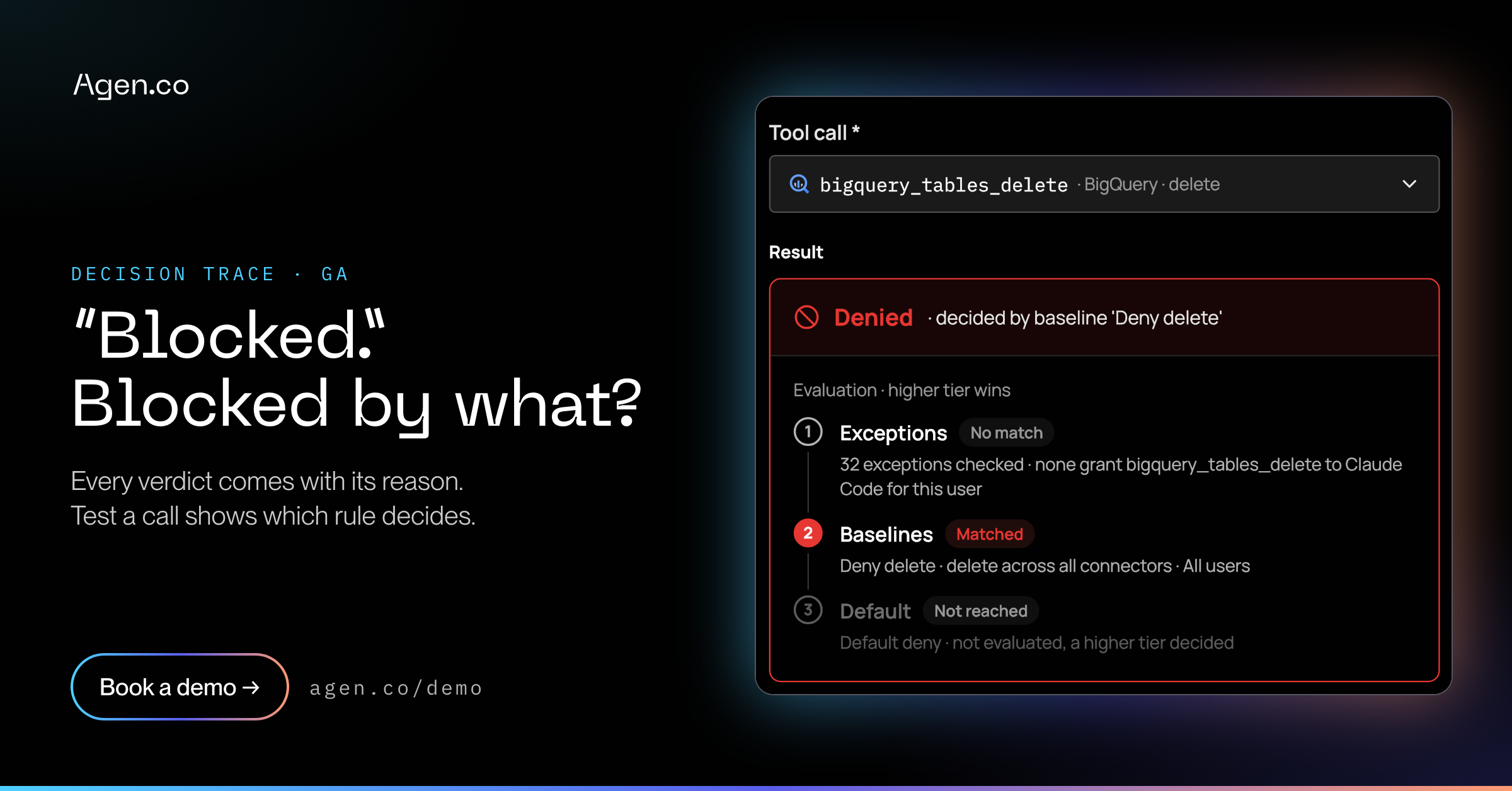
A blocked BigQuery delete in the Agen.co log, traced to the Deny delete baseline rule that decided it
Every block traces back to the rule that decided it.

You can also replay the request in Test a call. The engine checks exceptions first, then baselines, then the default. In this case, no exception matches, so the Deny delete baseline decides the call. The engine never reaches the default.

Now change the caller to someone in the data-platform group and run it again. Their exception matches, so the same delete is allowed. You can see exactly what changed between the two runs.

How do you go from “we should block that” to a rule?

Say you want to stop Claude Code from merging GitHub pull requests unless the person using it is on the release engineering team.

You can type that into the Rule assistant the way you’d say it to a teammate.

Don’t let Claude Code merge pull requests on GitHub, except the release-eng group.

The assistant proposes an exception that denies github_merge_pull_request for Claude Code for every user outside release-eng. You can review the proposed rule before you create it. Once you confirm, the next merge attempt that matches the rule is blocked, and the log shows which rule blocked it.
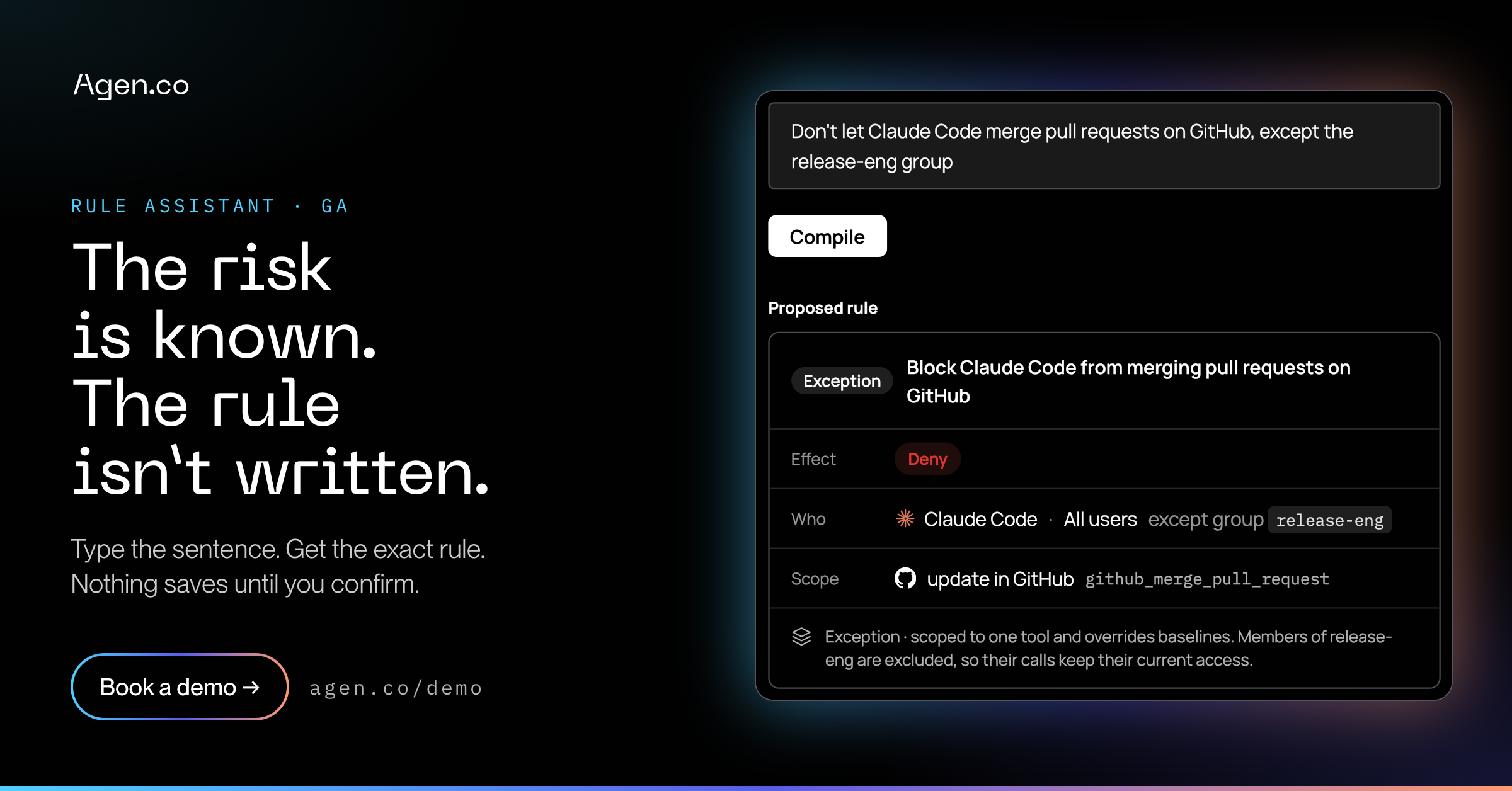
The Agen.co Rule assistant turning a plain-English request into a policy exception for GitHub pull request merges
Say the rule in plain English, review it, then save it.

What if nobody wrote a rule for that tool?

In the last walkthrough, a research agent spends the afternoon searching code and running queries. Those calls go through.

Then it starts making calls at 2 a.m. It uses a tool it’s never used before. It tries a bulk export from a network it’s never used before.

Behavior anomaly detection, under Security guardrails, treats each of those as a signal. Each match raises the request’s risk. You decide what to do at each risk level. In our demo, medium risk asks the user to confirm and high risk blocks the call.
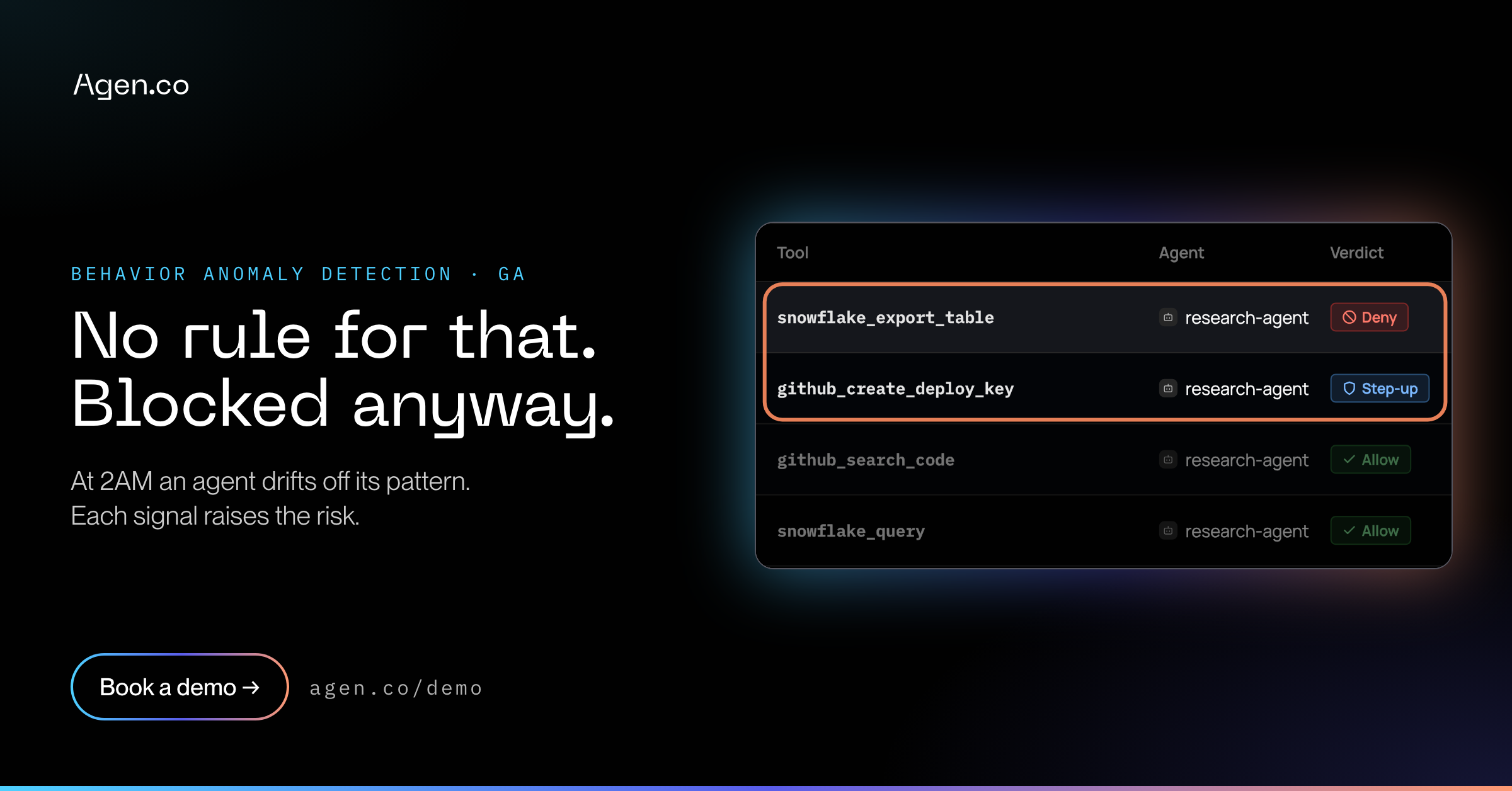
Agen.co behavior anomaly detection blocking an off-pattern bulk export with no tool-specific rule written
No rule for that tool. Blocked anyway, with the signals that raised its risk.

The export gets blocked even though there’s no rule written specifically for that tool. When you open the log, you can see which signals raised its risk.

What can the policy engine do with a call?

The walkthroughs show allow, step-up, and deny. There are five possible verdicts.

VerdictWhat happens
AllowThe call goes through and is logged.
Step-upThe user confirms before the call runs.
Human-in-the-loopThe call waits for a designated approver, like the finance team.
MaskThe call runs, and sensitive fields are masked before the response reaches the agent.
DenyThe call is blocked, and the log shows what blocked it.

The policy engine returns its verdict in under 30ms. If the call needs approval, it waits for the approver before it runs.

Where this fits in Agen.co

Discovery shows you which agents are connected. The MCP gateway is where governed tool calls run, across 150+ governed connectors and 1,000+ governed tools. The policy engine decides what happens on each of those calls. All three are generally available.

Watch the walkthroughs →

Have a call you’d want to handle differently depending on who’s asking or when it runs? Book a demo from the policy engine page.

Keep reading

More from Product

View all
Industry

How to Govern AI Agents in Real Time: A Verdict on Every Action

AI agent governance at runtime: why autonomous agents need a verdict on every action, and how each one traces back to the human accountable for it.

Agen.co·July 31, 2026
Research

The Agentic AI Security Gap: What the Data Says (And How to Close It)

Keon Armin

Written by

Keon Armin

Digital Marketing Manager

AI agents are already in your organization. Here's how to govern them safely before security falls behind adoption.

Rebecca NavehRebecca Naveh·February 24, 2026
Announcements

Introducing Agen.co for Work: Secure AI Agent Access for Your Entire Workforce

AI agents are already accessing enterprise tools. Learn how to govern them across 200+ apps with identity-aware access, role-based policy, and full visibility.

Rebecca NavehRebecca Naveh·February 24, 2026
View all posts

Frequently asked questions

What does the Agen.co policy engine evaluate?+
Every tool call an agent makes through the Agen.co MCP gateway. It decides each call using context like who is asking, what the agent is trying to do, and when and where the request comes from.
What verdicts can the policy engine return?+
Five: Allow (the call runs and is logged), Step-up (the user confirms before it runs), Human-in-the-loop (a designated approver decides), Mask (the call runs with sensitive fields masked in the response), and Deny (the call is blocked and the log shows what blocked it).
How fast is a policy engine verdict?+
Under 30ms. If the call needs approval, it waits for the approver before it runs.
In what order are policies checked?+
Exceptions first, then baselines, then the default. The first match decides the call, and the log shows which rule it was.
Can a call be blocked when no rule covers that tool?+
Yes. Behavior anomaly detection, under Security guardrails, treats signals like unusual hours, a never-used tool, or a new network as risk. You choose what each risk level does, for example step-up at medium and block at high.